

AI Porn Isn’t Regulated. What Does That Mean for Depictions of Queer Bodies?
“Transgender,” “Lesbian” and “Twink” are some of Pornhub’s most watched categories. What happens when you can create these types of porn with artificial intelligence?

This story was originally written for Gay Times Magazine. Keywords: AI porn, deepfake, adult content, AI trans porn, lesbian porn, AI models, child pornography
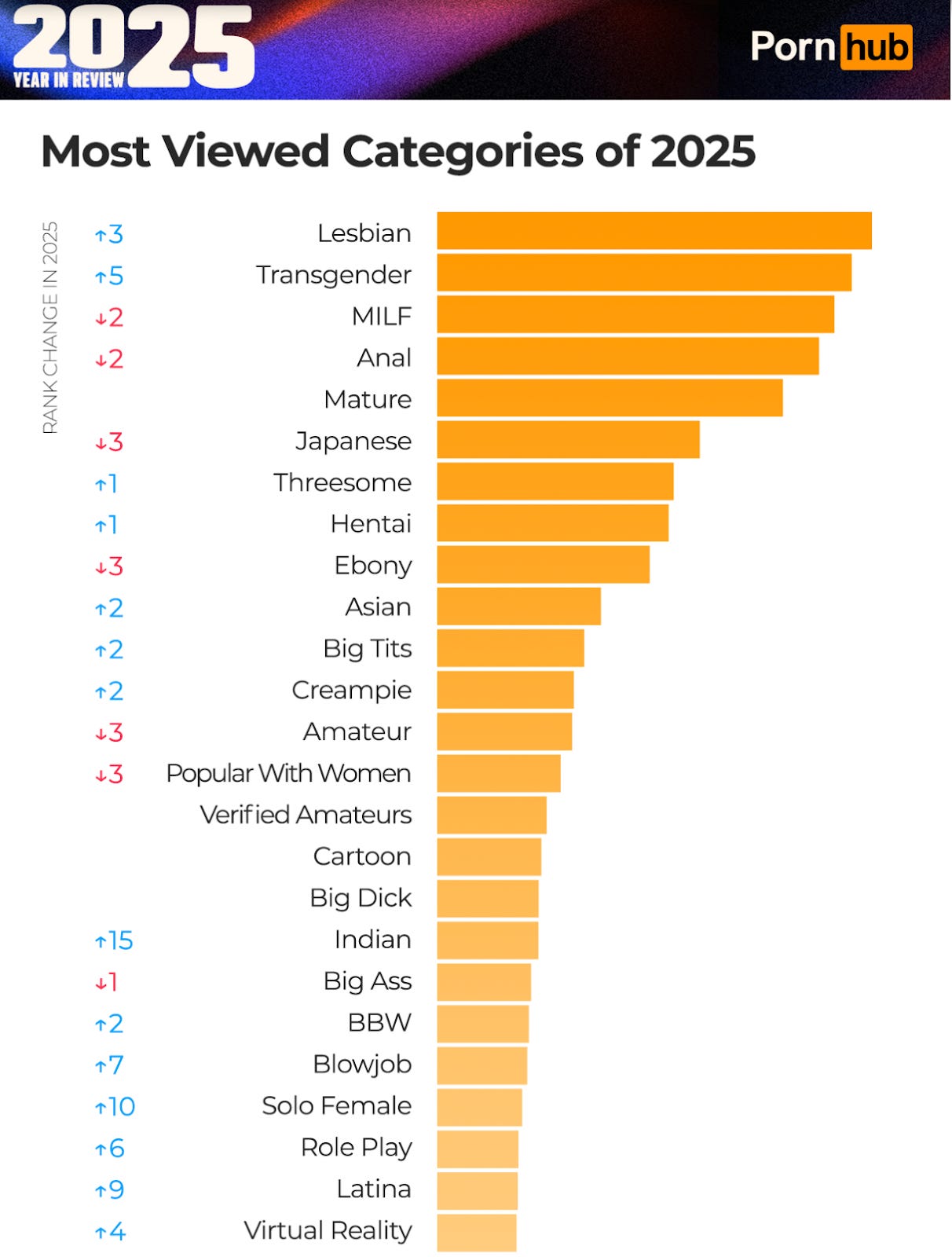
When Pornhub released its most-watched categories of 2025, queer-themed content held the top two spots: “Lesbian” was the most viewed category and “Transgender” was the second most viewed, up five spots from 2024.
The global appetite for LGBTQ adult content is increasing in tandem with the explosion of AI porn. Over the last year, Google searches for “AI porn generators” have steadily climbed, with one site receiving 8.57 million visitors in January. But unlike porn made up of real people, AI porn is largely unregulated, opening the door for the exploitation of queer bodies.
“More often than not, AI-generated pornography falls under this umbrella of ‘non photo-realistic media,’ or ‘non hyper-realistic adult content,’ not unlike illustration,” Aurélie Petit, a postdoctoral researcher at the Quebec research chair on French-language artificial intelligence and digital technologies, told Uncloseted Media and GAY TIMES. “And the moment you don’t know how to address this kind of content, then you don’t know what to do with a big part of AI adult productions.”
Though there have been steps taken to regulate the AI porn industry, there is still a long way to go. Last year, Congress passed the TAKE IT DOWN Act, which bans the publication of intimate, non-consensual images in the U.S., including AI-generated images. And the sharing of these images, known as deepfakes, is now a felony in Tennessee.
But much of AI porn isn’t based on one person’s likeness. Rather, it’s generated from a vast database of preexisting content used to teach the AI model. So any user who wants to create porn can simply ask an AI model to create their dream scenario, and—in a matter of minutes—a video to their liking that depicts realistic people is created.
“There’s a very real concern that some of the worst types of content on the internet—hateful content, non-consensual content of children … those exist on the internet, and we cannot verify that data sets [used to power AI algorithms] don’t include those images,” says Miranda Wei, postdoctoral fellow at Princeton University’s Center for Information Technology Policy.
Outside of deepfakes, U.S. laws leave AI-generated porn in a legal gray area, often varying by state or municipality. In California, Gov. Gavin Newsom signed a bill cracking down on deepfakes and requiring AI-generated content to be watermarked. But there is yet to be consistent policy across the board on how to legislate AI porn.
“When you have real people, or images that look like real people, we understand harm,” says Petit. “But most platforms do not know what to do. … It’s really a legal blur, a policy blur.”
Depictions of Trans Women
Because transphobic people make up a significant chunk of porn consumers, mainstream trans porn is often designed in a way that leans into prejudice. Videos using slurs or harmful tropes perform well on porn websites, and Google trends show that searches for “tranny porn” and “shemale porn” remain high. On Reddit, the largest trans-related subreddit is r/traps, a porn-sharing group named after a derogatory term that describes trans women as “traps” for cis men.
“[The internet] is still often reflecting a very heteronormative mindset. … Those preexisting biases for what kinds of content exists on the internet informs the data that is fed into those AI models,” Wei told Uncloseted Media and GAY TIMES.
A quick search for “AI trans porn” produces countless generated images of hyper-feminine trans women with unrealistically large penises, often the same length as their torsos. Other videos show trans women being penetrated by men with penises so large that, in real life, they would inevitably cause physical harm.
“When they say trans, you need to really understand it’s trans women, and a trans woman who still has a penis … it’s really a fetishization of trans women pre-operation,” Petit says.
One of Google’s first search results for “AI trans porn” is for CreateAIShemale. On the site, users can build a trans woman from a wide variety of options. They can choose her age, the size of her breasts, butt and penis, and select from nearly 70 modifiers including “bimbo,” “spanked, hand print,” “impregnation” and “pony cock.” The site also lists 42 options for “race,” with strange inclusions such as “goblin” and “green skin.”
On a separate but similar site, the owners write: “Your fantasy, your rules. With Trans AI customization, you can design every detail of your AI companion—from physical characteristics and outfits to voice tone and personality traits. … Our shemale AI models can generate images and videos on demand, making your interactions more vivid and exciting. … Shemale AI makes it possible instantly.”
Brandon Robinson, associate professor of Gender and Sexuality Studies at the University of California, Riverside, says these infinite customization options are concerning: “[It] can further the objectification of trans women, as it treats them as just sex objects that can be changed and customized to one’s own likes and desires,” they say. “It also erases that trans women are real, actual human beings, with their own wants, needs, and desires.”
Beyond the fetishization lies a celebration of violence against trans women. A quick search yields videos with headlines that include “AI Generated Shemale Getting Destroyed by a Massive Dick.”
Robinson says these depictions exacerbate preexisting stereotypes. “A lot of men come into dating or hooking up with trans women with these stereotypes.”
Depictions of Gay Men
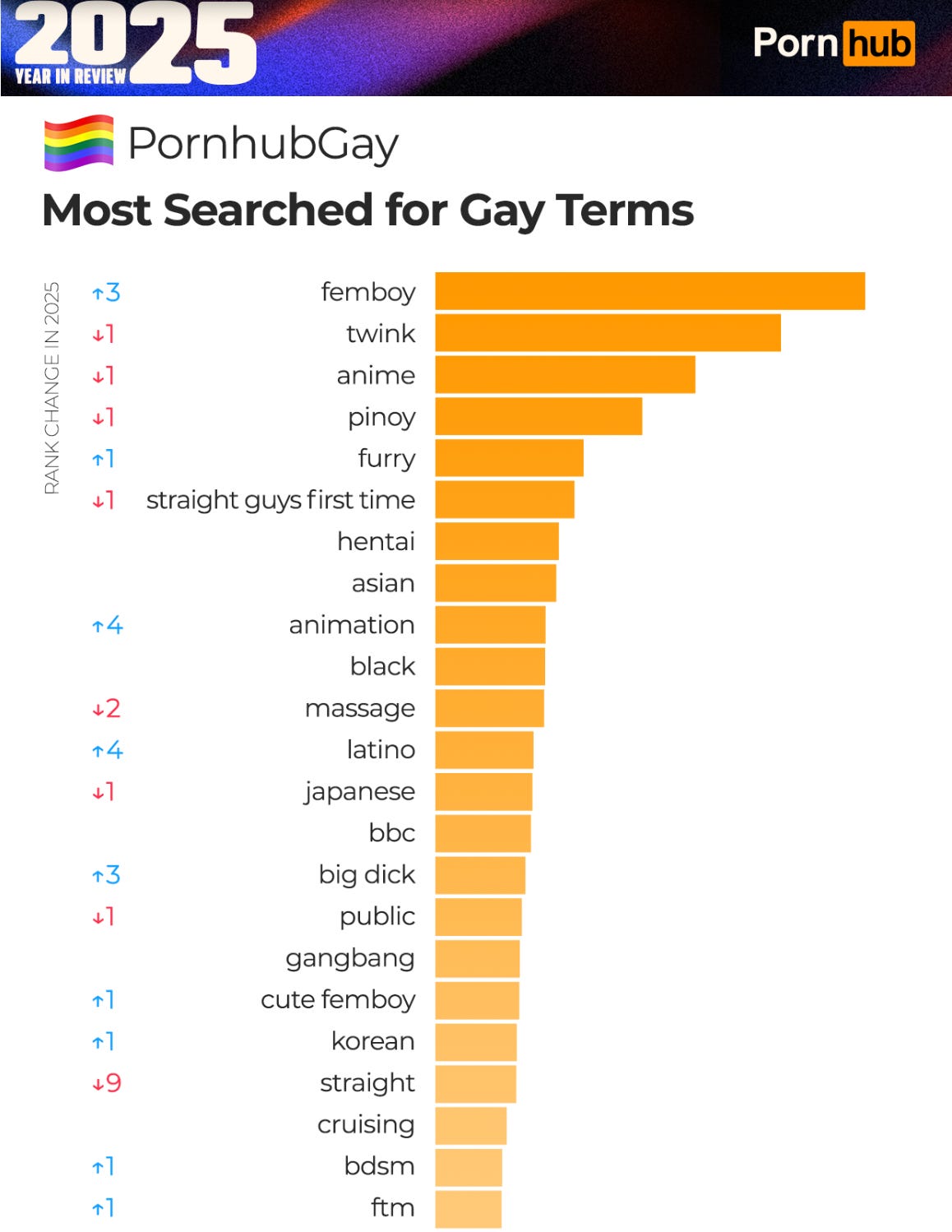
While deepfake laws in the U.S. now offer some protection, AI porn that isn’t based on one person’s likeness is harder to prosecute. And that’s concerning when you look at the global appetite for gay porn. In 2025, Pornhub reported that “femboy” and “twink” were the site’s two most searched for gay terms. And “Femboy Fixation” was one of the top five trends that defined 2025, with searches for “cute femboy” and “sexy femboy” up 79% and 93%, respectively.
What’s concerning is that AI has the ability to produce depictions of categories—which are code words for skinny, younger men—that take it to the next level. Many AI-generated depictions of these men show very thin, often emaciated, bodies. “It’s giving very unrealistic body ideas,” Robinson told Uncloseted Media and GAY TIMES. “And we know that there’s a history of eating disorders and body dysmorphia within the gay community.”
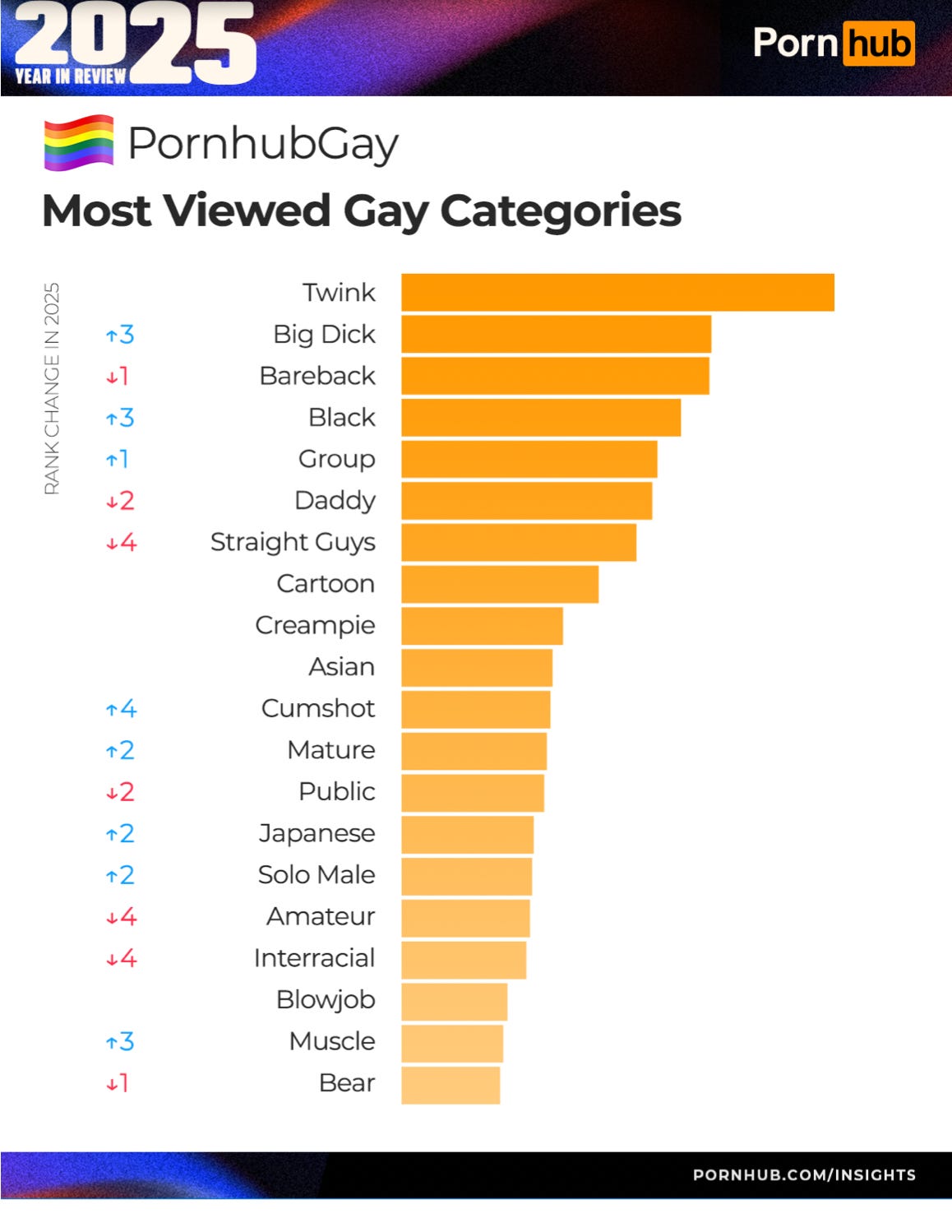
Depictions of children in AI porn is another space that has opened the door for bad-faith actors. A 2026 issue brief from UNICEF found that across 11 countries, at least 1.2 million children reported having had their images manipulated into sexually explicit deepfakes through AI tools in the past year. And while there have been regulations on deepfakes, groups devoted to creating twink and femboy AI porn can create videos that depict youthful, small bodies, potentially making content that blurs the lines between adult content and child pornography.
While some may find it hard to believe that something as sinister and criminalized as child pornography could be informing AI models, Wei says it’s happening. “Using Child Sexual Abuse Material (CSAM) is definitely not legal. It is awful. But lots of illegal things still happen,” she says. “People do use generative AI to generate AI CSAM, because the models have probably ingested CSAM before.”
Lesbian Porn and AI
Unrealistic depictions of lesbian sex are also popping up in AI porn. One AI-generated lesbian porn video shows a woman licking semen out of another woman’s vagina—inserting an invisible male presence into sex between women.
Another disturbing part of AI’s representation of lesbians has to do with how it often makes women look identical. In one AI-generated image, two lesbians in matching black bikinis sit on the beach. Their haircuts, facial features and bodies are the same. Through these kinds of images, AI risks encouraging viewers to overlook women’s individuality or—worse—lean into the fetish of incest.
In addition, many of the AI-generated depictions of women are feminine, extremely thin, white, and often have unrealistically large breasts and butts. While these attributes are already sought after in conventional porn, AI generators have the ability to produce depictions of women with impossible body proportions.
“[AI porn] maintains unrealistic beauty standards that most people can’t conform or live up to but also it pushes most people out of being seen as desirable and beautiful,” says Robinson.
The Impact on the Viewer
AI-generated porn can be harmful for those who watch it, especially for young people: Pornography is already highly addictive, with one study finding a 91% increase in pornography consumption since 2000. Another study found that between 17-24% of adolescents have experienced a dependency on AI.
Wei finds this troubling because much of how AI porn is generated is a black box. “From a consumer standpoint, you don’t really have the ability to audit how this tool was made,” she says.
Because of this, users may unknowingly consume media that is based off of abusive imagery or even child pornography. This is because the massive amount of data that tech companies use to feed their AI models is gathered from across the internet, making it impossible for individuals to vet each piece of information. “It feels more risky to use it when you don’t know who created [the AI porn], what their intentions were, or how they collected the data that was used to make it.”
Wei says what’s most concerning is that the data that tech companies use to feed their AI models is not always publicly available. “Large tech companies can be very protective of where they get their data. That is part of their business,” she says. “The scale at which these data sets are being collected means that you cannot have a human manually go through and verify that every piece collected was consensual [or] that a queer person was accurately depicted.”
What Can be Done?
Some popular generative AI models say there are safety regulations in place. ChatGPT’s website states that the model cannot be used for the creation of “illicit activities” or “sexual violence.” But Petit says that bad-faith actors may still succeed in skirting regulation. “There’s so many AI generators, and there’s people whose entire game is to break the generation,” she says. “You can tweak it more and more and can make the AI do something it doesn’t want.”
In one Reddit thread, a user of Elon Musk’s Grok expressed frustration about newly developed moderation making it harder to generate explicit images. In response, another user seemingly confirmed they were able to find a workaround: “Right now I’m generating realistic videos of completely naked men with tentacles and fluids and non-con sex talk and moans and it works great,” the user wrote.
The potential for nefarious uses of AI came to light when it was revealed that, starting in December 2025, Grok produced and shared upwards of 1.8 million sexualized images of women over the course of nine days. “As we’ve seen with Grok and the numerous scandals over the past few years, the ability to stop an AI model from creating explicit imagery of someone is … unsolved,” Wei says.
Wei doesn’t have a bulletproof solution. “I’m not necessarily aware of a universal technique that could prevent, 100% of the time, the creation of images of other people,” she says.
There are, however, strategies that help safeguard AI models. For example, red teaming, which consists of prompting an AI model to generate illicit content, is an ethical tool companies can use to spot regulatory weaknesses. “[It’s] a way to adversarially test, to attack a model and see if it can do harmful things which you are trying to prevent it from doing,” says Wei.
With some companies like Google employing hackers to red team in hopes of identifying security concerns, Wei thinks other AI companies should do the same.
Another approach lies in public model cards, which are small files accompanying AI models that provide information about the data the model was trained on, as well as the AI’s intended use and limitations. Both of these methods are in pursuit of transparency, which Wei sees as necessary to safer AI use. “There should be a way to make technologies safe when people want to use them. … Transparency is needed in order to make progress on safety issues, but that’s again, ongoing.”
In the meantime, Wei says that “tech companies and lawmakers need to step up” and implement greater regulation around AI porn. “Effective regulation also needs the input of people who already have lived experience with pornography, like sex workers and adult actors, and anyone who would be depicted in this imagery.”
Additional reporting by Spencer Macnaughton and Hope Pisoni
If objective, nonpartisan, rigorous, LGBTQ-focused journalism is important to you, please consider making a tax-deductible donation through our fiscal sponsor, Resource Impact, by clicking this button:

 | A guest post by
|
It is really frustrating to read an article about the dangers of generative AI that uses porn as an example, without an actual understanding of porn, the industry, or the extensive legal history of this exact discussion. For example, this "Pornography is already highly addictive, with one study finding a 91% increase in pornography consumption since 2000" has two completely different thoughts that are based in stigma, not science. Many, many queer activists and advocates work specifically on the regulation of the internet and the potential harm to queer people. This is a personal essay.
Aside from making every "character" (if you will) look like a cartooish blow-up doll, it's completely nonsensical. Generative AI should have been shut down before it ever became public.
Small analytical/hypothetical sidenote, I'm almost certain that the exaggeration of proportions/lack thereof probably does indeed originate from the absorption of drawn porn into the same data sets as photographic porn. It makes sense, doesn't it?