

At 11, My Identical Twin Started to Transition. It Changed My Life.
My brother’s metamorphosis into his true self has taught me so much about the transgender community.
By: Elizabeth Smith
Given the current climate for transgender people in the U.S., pseudonyms have been used for the author and her twin.
James decided to use his name and pronouns prior to transition in this story because he feels it is representative of the beginning of his transition, which he says is an important part of his story.
When I was a little girl, I loved brushing my twin sister’s hair. Julia always hated dealing with it and would ask me to sling a hair tie around it three times to make an extra-tight ponytail. Before leaving for elementary school each morning, either my mom or I would use spray and bobby pins to trap her hair in place.
It was hard to watch all of that long blond hair fall on the floor at the hairdresser’s in Atlanta in 2015.
At 11 years old, I remember sitting in the waiting chairs with my mom, who was crying out tears that mingled both salty grief and sweet relief.
Despite my own feelings of sadness, I remember looking at Julia’s reflection in the salon mirror. Above where the black salon cape was fastened around her neck, all I could see was a beaming smile that took up her whole face. I couldn’t remember a time when I had seen her like that.
She left the hair salon that day with a short, side-swept fringe. A boy’s haircut. Soon after, Julia started going by James and using he/him pronouns.
While my brother and I are identical twins, we do not share the same gender. This has been my reality for over a decade. James’ metamorphosis into his true self has taught me so much about the transgender community. I also believe my perspective as the identical twin of a trans person can be a valuable offering to help people who misunderstand the community—or see gender as a so-called social contagion.
Here’s my story.
A few months before the salon visit, I was sitting in my bedroom on my iPad that my grandmother had just gifted me for my 11th birthday. I had been watching YouTube videos of people making wearable mermaid tails from waterproof fabric.
I came across a video on TMZ of Jazz Jennings, a 14-year-old girl who was swimming in a purple mermaid tail. In the video, Jazz explained that she was transgender and that she loved wearing the tails because they made her forget what was between her legs.
Jazz was the first openly transgender person I had ever come across.
I ran to my mom, who was sitting in Julia’s room with her. “I think this is what Julia is,” I told her while I pressed the video up to her face.
I remember Julia watching inquisitively as my mom tried to hide her reaction. Though Julia didn’t say anything, I think that’s when she had finally been able to put a label on the feeling she had felt her entire life: transgender.
Somehow, I had always had a sense that I had a twin brother, not sister.
Growing up, I liked Barbies. My twin, on the other hand, dressed up as a muscly cop for Halloween two years in a row. On character history day in elementary school, she fought tooth and nail to dress up as Christopher Latham Sholes, the inventor of the typewriter, instead of women’s rights activist Susan B. Anthony. After her teacher said she had to dress up as a female figure, she dressed as Sholes anyway.
At our fifth-grade graduation ceremony, the school told her she needed to wear girls’ formal attire. Still, Julia strode across the stage in a tiny tux, becoming the first known girl at the time to sport such an outfit in our Georgia elementary school.
Shortly after showing my family the video of Jazz, my memory feels like a series of vivid scenes.
There’s a scene of me, Julia and my mom at Kohl’s shopping in the girls’ clothing section for back-to-school outfits. Julia clutched her chest, hard, and told my mom she couldn’t breathe. She was having a panic attack, but couldn’t articulate why.
After my twin told us he wanted to change his pronouns and go by James, there’s a scene of my mom pacing the house frantically, tearing paintings of me and my twin off the wall, and flushing them down the toilet as she sobbed through clenched teeth. Though my mom wanted what was best for her child, it was hard for her to come to terms with the changes. For the first few months after the name change, she said she felt like Julia was “gone.”
Shortly after starting at a new middle school in Georgia, James was diagnosed with gender dysphoria after starting therapy. With seventh grade and puberty just around the corner, my mom had no idea what to do next. So we went to see our childhood pediatrician, who told her that “this was just a phase” and that my brother would “get over it soon enough.”
I knew our doctor was wrong.
I remember the three of us going to our long-time Methodist church to ask our priest for guidance. The priest responded with a typical “We love you… BUT” monologue. My mom asked the priest to pray for my brother’s mental health, but the only thing my priest must’ve heard was “transgender,” and the only thing he must’ve thought was “sin.”
I knew our priest was wrong.
Eventually, my mom made the decision to leave our red state, which currently has 12 anti-trans bills making their way through the state legislature. She wanted to find a place where my brother would be accepted. A place where he could find therapists and doctors who would help him figure out what to do next. We packed up our house, where James and I were born and raised, and drove to our new home in Colorado.
Shortly after arriving, I remember harrowing screams—the kind that are fueled by sheer panic—from my brother in our new living room after he got his period. He had menstruated months before me, and had started puberty blockers too late because doctors in Georgia wouldn’t help him.
As the years passed, my brother got the gender-affirming care that I watched save his life. As the dysphoria lifted, he had fewer panic attacks.
As James moved toward his true self, I sort of became the control subject of an experiment. When he started hormones at 15, we began looking different for the first time in our lives. His face grew more angular than mine. A blond mustache came in, followed by an adolescent beard. He grew an inch taller. His frame filled out in ways mine never would.
I was a living measure of how far he had traveled from our original shared image.
But so many things were unchanged. We still had the same smile, the same laugh, the same cadence, the same timing. Our hair color and our eyes still matched. He was a boy now, and I was not. But we were still, somehow, the same.
I’ll admit, it took some adjusting. It’s well-known that identical twins cherish their identicalness. I mean, how cool is it when two people look exactly the same? But when I look at my brother now, I don’t mourn Julia—I still see James as the person I’ve known my whole life: My platonic soulmate, my best friend and ride-or-die. My twin.
Today, people often say to us, “You look awfully alike for boy-girl twins.” Each time they ask, we give each other a knowing look before we say “fraternal” in an effort not to confuse them. People nowadays have a hard time coming to terms with the sentence, “We are identical, but we are different genders.”
I wish more people could have the privilege I had of learning about the trans community. At 11 years old, I learned the difference between gender and sex. At 12, I learned that someone who identifies as one gender may begin to experience the puberty associated with another gender and that a mismatched puberty can be detrimental to their mental health. And at 13, I learned what gender dysphoria really meant after my twin was diagnosed with it.
My brother’s experience taught me that the societal construct of the gender binary of “man” and “woman” is unfixed and subjective. For us, even as two identical little “girls,” I now realize how idiotic it is to assume we both craved pink Barbies.
Today, dozens of states have passed laws restricting or banning the gender-affirming care that allowed my brother to become his true self. I think about the times when he clutched his chest in the girls’ section of a department store. Or when he flexed for photos in his muscly cop costume. Or when he screamed in our Colorado living room as if the world was ending.
I think about all of it when people tell me transgender identity is a choice, or a phase, or a contagion. I was there. I witnessed his yearslong transition.
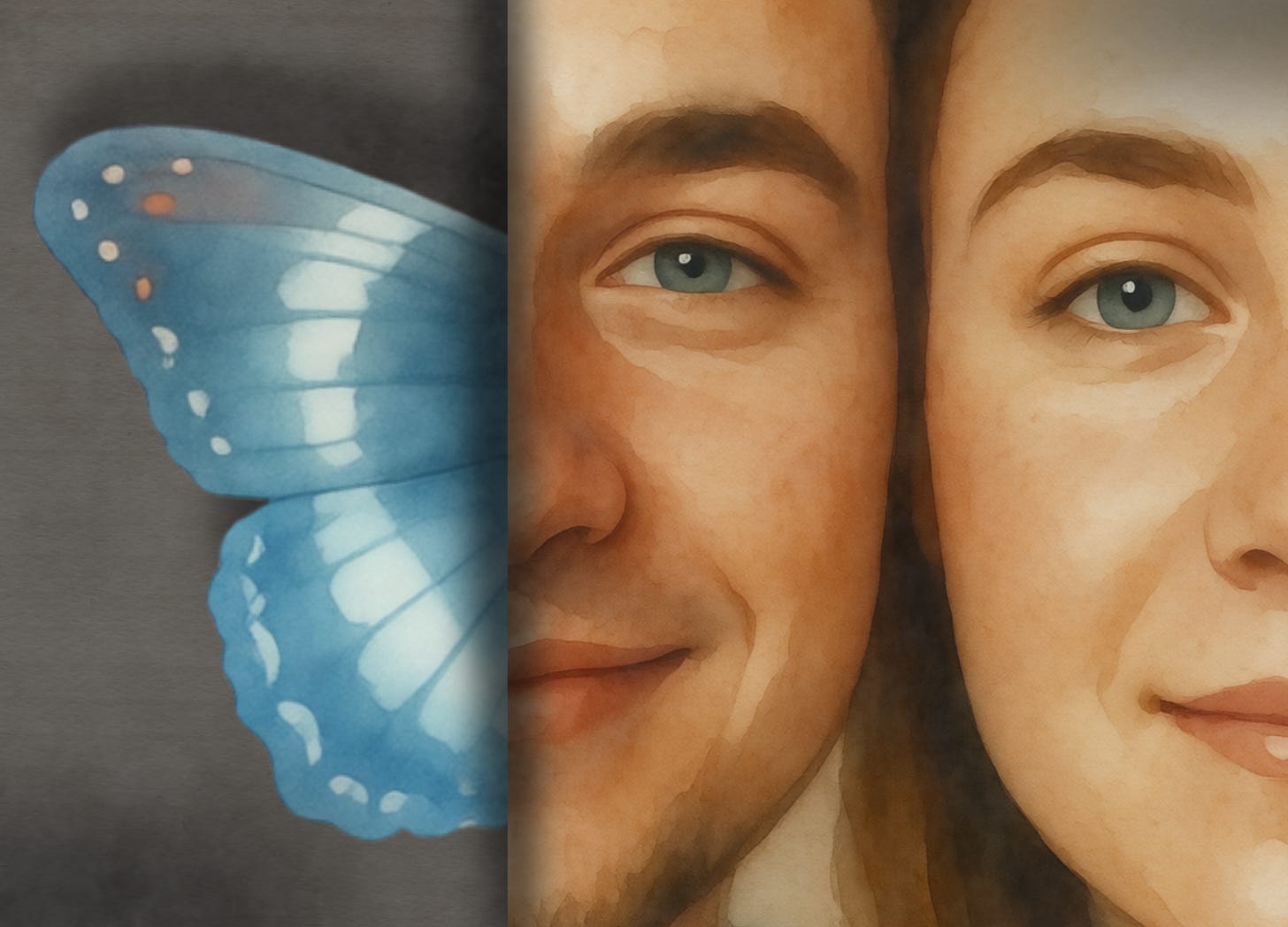
While Julia might have been the caterpillar version of my brother, who James is today is a metamorphosed butterfly. And damnit, that butterfly is the most beautiful thing I’ve ever seen.
I love you, James.
If objective, nonpartisan, rigorous, LGBTQ-focused journalism is important to you, please consider making a tax-deductible donation through our fiscal sponsor, Resource Impact, by clicking this button:

This story really resonated with me. As the parent of a transgender child, the feelings and uncertainty surrounding their transition in a rural Texas town are very similar. I wish the world was kinder.
A beautiful story I wish more people would be understanding. In my Province in Canada is just put in laws to ban medical care for transitioning.