

For the Parents of Intersex Kids, Deciding how to Proceed Isn’t Easy
In the U.S., thousands of infants with intersex traits undergo medically unnecessary genital surgeries each year, often before they can consent.

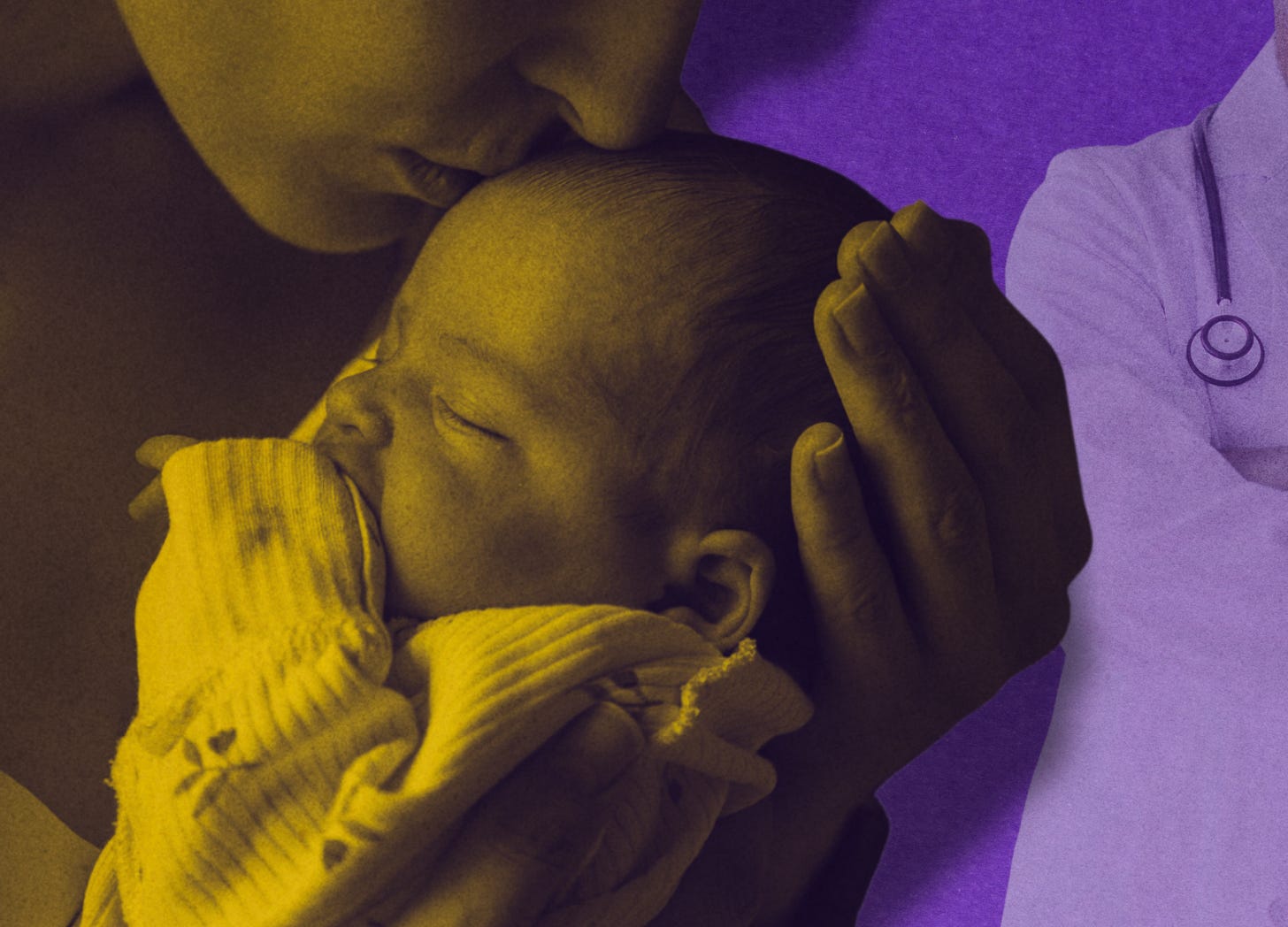
This story was originally written for Gay Times Magazine.
Editor’s note: To protect Zebb’s privacy, this story uses pseudonyms for him and his parents.
In the fall of 2023, Cindy Howard was in a hospital bed recovering from a cesarean section.
While the birth had gone smoothly, the pregnancy itself carried intense uncertainty.
In the months leading up to the delivery, a technician had indicated she was expecting a girl.
But during an ultrasound at around 30 weeks pregnant, she was told that while her baby had no visible penis, there were testicles. “We figured it was just a bad angle,” Howard told Uncloseted Media and GAY TIMES.
“We went to a 3D ultrasound just for fun. And then we spent about 10 minutes looking for the penis, and we couldn’t find it,” says Max Wilson, Howard’s husband.
Even though follow-up ultrasounds did not identify a penis, Howard’s doctor eventually confirmed XY chromosomes, which signify the sex is male.
Through the remainder of Howard’s pregnancy, the results were ambiguous. And by the time the baby was born, there was still no clear picture.
After giving birth, Howard remembers a doctor entering the room. “XY chromosomes,” she remembers being told.
“I already knew he wouldn’t have typically male genitalia,” she says. “There was some relief in finally knowing for sure.”
“Initially, they just told us he had a micro penis,” says Wilson. “Full transparency, we were both really disappointed to hear that. … Our culture is not kind to anybody’s body differences. You start looking ahead and thinking, ‘I don’t know what that’s going to look like for [his] life.’”
Doctors told Howard and Wilson that the sex of their child was to be decided by them. So later that day, they chose male.
Howard says it felt like the most logical decision, given her child had testicles and XY chromosomes.
“We did ask the pediatrician at the hospital after testing. She didn’t think there was any reason to not consider him a boy at that point,” she says.
But what followed would prove to be far more complicated.
What Doctors and Research Say about Surgery
Howard’s child, Zebb, was born intersex, which is an umbrella term for a range of variations in sex characteristics—including chromosomes, hormones, reproductive anatomy and genitalia—that do not fit binary definitions of male or female bodies. Intersex is not a single condition, but a broad category that can include differences noticed at birth, during puberty or later in life. It is distinct from both gender and sexual orientation.
An estimated 1.7% of people have intersex traits. While many intersex infants undergo genital surgeries each year, parents may opt to delay or forgo surgical intervention altogether, allowing their children to grow up without procedures that are medically unnecessary.
These surgeries are often justified by the anticipated psychological harms of appearing intersex, even though the decision is made many years before the child is old enough to weigh in.
For expecting parents whose minds may be clouded with worry, Dr. Arlene Baratz, a physician and advocate for intersex rights, underscores that there is nothing wrong with intersex children. According to her, about 1 in 100 people have such variations, making them almost as common as white people with red hair or green eyes.
A month after giving birth, Howard and Wilson returned for a follow-up appointment with a pediatric urologist. Additional testing confirmed that Zebb’s urinary function was adequate. At that stage, no surgical intervention had been scheduled, and the discussion remained focused on whether any treatment, which could be performed mostly for cosmetic reasons, would be considered.
The doctor examined Zebb and diagnosed him with epispadias, a rare condition where the urethra does not form in the typical position. In boys, it can mean the opening is located along the upper side of the penis rather than at the tip. In some cases, including Zebb’s, the penis appears shortened or buried. The condition affects roughly 1 in 117,000 male babies.
“He would definitely need surgery,” Howard recalls the doctor telling her. “If not, he [will] be very unhappy with his penis.”
“It’s just like the wildest thing to say,” Howard says. “Because he’s a literal newborn.” And already, someone was predicting his future dissatisfaction with his body and his identity.
Howard threw herself into researching Zebb’s diagnosis and joined intersex parent support groups on Facebook. She ultimately decided that surgery was not what she and her husband wanted. So she did nothing.
Baratz, who has two daughters with intersex variations, says surgeons often tell parents that tissues heal best if surgery is done in infancy. “Parents hear, ‘If you don’t do this now, it won’t work.’ This creates a false urgency,” she says.
This framing can leave families feeling as though there is only one acceptable path forward, even when medical opinions differ on timing and necessity.
“Parents are emotionally vulnerable in the delivery room,” says Baratz. “They’re being told something is wrong, [and] the solution is surgery. It’s a high-stakes decision made in a moment of shock and fear. … When families are overwhelmed and processing complex information, it can be difficult to fully engage with the range of options presented.”
On the flip side, Baratz says pediatric urologists face pressure to recommend early surgeries based on parental assumptions about functionality and appearance.
These preconceived notions may not be justified. In a 2017 statement from three former U.S. surgeon generals, they wrote that there is “insufficient evidence that growing up with atypical genitalia leads to psychosocial distress,” and that much of the justification relies instead on clinical assumptions about future well-being. They add that there is clear evidence that “the surgery itself can cause severe and irreversible physical harm and emotional distress.”
The Weight of Immediate Choice and Children’s Rights
These quick parental decisions are controversial as they relate to children’s rights.
“Children cannot consent to these surgeries, yet they carry lifelong consequences,” Sylvan Fraser Anthony, legal and policy director at interACT: Advocates for Intersex Youth, told Uncloseted Media and GAY TIMES. “Legally, there’s tension: Physicians recommend interventions [and] parents consent, but the child is the one whose autonomy is compromised.”
According to one 2017 report by Human Rights Watch and interACT, these surgeries “can inflict irreversible physical and psychological harm” on intersex kids “that can last throughout their lives.” And a 2023 study found that these nonconsensual surgeries increased medical mistrust among intersex individuals, which in turn contributed to avoidance of healthcare.
The Psychological Impact on Parents
Niki Khanna, a marriage and family therapist and board member at interACT, has spent years examining how doctors communicate with parents. She says predictions about future psychological harm are rooted less in evidence and more in a mid‑20th‑century theory that anatomical conformity shields children from future psychosocial harm.
“When physicians tell parents that a child will be unhappy with their body, they are often projecting a binary framework—one that assumes there is a correct way for a male or female body to look and function, and that deviation from that norm will inevitably lead to distress,” says Khanna, who is intersex.
“Doctors are often presenting it as if there’s only one option … and if you don’t choose [surgery], you’re neglecting your child.”
Khanna says parents are rarely given space to understand variation outside of this clinical lens, which can make refusal feel morally fraught.
When Howard and Wilson sought out additional opinions, including a consultation with a specialist at a children’s hospital in Ohio, they asked a question that few clinicians could answer clearly: Are children who undergo these surgeries happy with the results?
“The parents are happy,” the specialist told them.
“I don’t care about the parents,” Howard responded, insisting that she was more interested in what intersex individuals themselves felt. The answer was murkier. Here, the specialist said that some patients were not satisfied, but that could be attributed to being “angsty teens.”
“Many adults report dissatisfaction with early surgeries, not necessarily because of function, but because they never had a voice in decisions about their own bodies,” Holly Nelson, a therapist who works with intersex adults, told Uncloseted Media and GAY TIMES.
Do Intersex Children Have Any Legal Protections?
Children have very few explicit protections preventing nonconsensual, cosmetic genital surgeries.
Fraser says that this system rests on a legal assumption that is rarely interrogated: “There is a legitimate question that’s not often really taken seriously about whether parents even have the legal authority to provide valid consent to these decisions.”
Fraser notes that while parental consent is broadly accepted in U.S. pediatric medicine, it is not absolute in law, especially in cases involving irreversible procedures.
“Procedures like sterilizations … are typically either flat out outlawed or require individual informed consent from the actual person whose body it is,” they say. Intersex advocacy groups argue that this same logic should apply to non-urgent, irreversible genital surgeries in infancy. But in practice, it is not consistently enforced.
Fraser says that some countries outside the U.S. have begun to delay non-urgent medical decisions until intersex children are old enough to participate.
In 2015, Malta became the first country to pass a law banning nonconsensual medically unnecessary surgeries on intersex infants. The law draws a clear line between urgent care and procedures that can wait, requiring doctors to postpone cosmetic or nonessential interventions until the individual can decide for themselves.
Other countries in Europe and Latin America have introduced similar policies. But these protections vary widely in how they are applied, and in many places, enforcement remains inconsistent.
‘It’s Going to Be Okay’
Two and a half years after making the decision not to have Zebb undergo surgery, Howard says the journey has been intense, but support groups have helped her along the way. “Talking to other parents helped me understand that surgery isn’t always the answer,” she says. “But it doesn’t erase the fear you feel in those first days, when the decision feels life-altering.”
Experts agree that transparency, patience and consideration of adult outcomes are critical.
“Parents should hear about the risks, the uncertainties, and the experiences of adults who lived through early interventions,” says Baratz. “Only then can they make a decision that truly respects the child’s future.”
Despite the stress Howard faced in determining whether or not to proceed with surgery, she says Zebb is enjoying his childhood.
On any given afternoon, he might be seen running across the living room floor, a small fleet of toy cars scattered behind him.
“[He] exclusively loves Hot Wheels,” says Howard. But he also plays with a baby doll he got for Christmas, and his favorite color was pink for a long time.
“We were very like, ‘You like what you like. … You point to it, you pick it.’”
“The most important thing that you can do for any child is to love them and make them feel confident, and that’s really your job,” says Baratz. “Your child has every expectation of having a beautiful life and being able to do everything that anybody else is able to do. It is going to be different. But you can do this, and it’s going to be okay.”
If objective, nonpartisan, rigorous, LGBTQ-focused journalism is important to you, please consider making a tax-deductible donation in the U.S. through our 501(c)(3) fiscal sponsor, Resource Impact, by clicking this button:
If you’re in Canada and would like to donate, you can make a charitable tax-receipted donation here:

 | A guest post by
|