

Inside the Canadian Christian Lobbying Group Pushing Anti-LGBTQ Policy
ARPA lobbies in support conversion therapy and against gay marriage and transgender rights.

This story was originally written for Gay Times Magazine., Keywords: ARPA Canada, Christian nationalist groups in Canada, Anti-LGBTQ lobbying in Canada
In October 2025, Canadian politicians from British Columbia (B.C.) gathered in the provincial capital to vote on a motion to symbolically condemn the “intolerant” and “harmful” views of the Association for Reformed Political Action (ARPA), a far-right group that describes itself as a “Christian political advocacy organization.”
“They are an organization that wants to end the federal ban on the documented, harmful and sinister practice of conversion therapy,” Rohini Arora, a member of Canada’s left-wing New Democratic Party, argued to her colleagues. “They’re the harassers in that story. The things that they stand for are about not letting people be who they are, not letting them love who they love.”
Every Conservative politician in the room refused to vote on the motion and instead walked out. This was likely due to former Conservative Party leader John Rustad asking his party members to “not participate in divisive politics.”
Despite the motion passing 48-3, ARPA is very active in Canadian politics. They’ve filed 322 communication lobbying reports with the Canadian government since 2012. Some of these include efforts to eliminate education around sexual orientation and gender identity in B.C.’s schools, as well as end access to gender-affirming care for minors. One of ARPA’s current fights is to overturn Canada’s ban on conversion therapy.
“Someone who struggles with unwanted same-sex attraction or sexual behavior … should be free to seek help to live their beliefs and identity, but this law forbids it,” ARPA states in an article titled “Changing Canada’s Conversion Therapy Ban.”
History and Leadership
Founded in 2007 as a national nonprofit, ARPA is associated with Reformed Christianity—a denomination that stems from the Protestant Reformation. The Christian Reformed Church states that “homosexual practice … is incompatible with obedience to the will of God.” Homosexuality is described as “a condition” for which Reformed Christians “must exercise the same compassion for same-sex oriented persons in their sins as [they] exercise for all other sinners.”
In an article published by a Reformed Christianity journal, pastors with trans congregants are advised that “the first line of response should be to call for confession and repentance.” The article encourages trans people to detransition by “correct[ing] or revers[ing] any steps that have been taken in the wrong direction (whether hormone treatment or reconstructive surgery).”
Since their founding, ARPA has grown significantly. According to their website, they have at least 12 employees, as well as main offices in southern B.C. and Ottawa, and chapters in Ontario, Alberta and B.C.
Many of ARPA’s lobbyists aim to push the Canadian government to pass anti-LGBTQ policies. Levi Minderhoud, ARPA’s B.C. manager—who has advocated for “the elimination of [sexual orientation and gender identity] in [B.C.] schools”—wrote an article in which he calls out “gender identity warriors.” In the piece, he quotes The Heritage Foundation, a right-wing think tank that penned Project 2025.
“It’s time that the Ontario Progressive Conservatives live up to their name, listen to Ontarians, and remove gender ideology from the classroom,” Minderhoud writes.
Through the years, ARPA’s anti-LGBTQ push has been prevalent in their communications. In a 2020 letter to pastors of Christian congregations in Canada, ARPA’s former director of law and policy, André M. Schutten, urges recipients to push back against the country’s new conversion therapy ban.
“Brothers, as Christians, we recognize that same-sex sexual desires and conduct, like any sexual desires or conduct that do not conform to God’s norms, are wrong and we must repent of them. … If this bill passes unamended, aspects of your ministry (to youth in particular) in an age of sexual confusion would be criminalized,” Schutten writes, adding action items that include praying, praying again and writing a letter to their Member of Parliament (MP).
Current Lobbying Efforts
Fast forward to now and ARPA is continuing a push to overturn Bill-C4, Canada’s conversion therapy ban, which illegalizes the ineffective practice linked to poor self-esteem, substance abuse, anxiety, depression and suicidality.
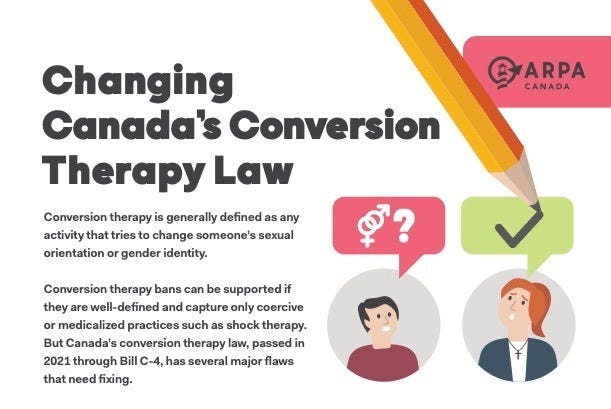
In defending their critique of the bill, ARPA quotes the late American psychologist Joseph Nicolosi.
Nicolosi authored “A Parent’s Guide to Preventing Homosexuality” and was a founder of the National Association for Research & Therapy of Homosexuality, an organization that promotes conversion therapy.
ARPA is also working against the Combatting Hate Act, or Bill C-9. If passed, this bill would lower the threshold for what counts as hate speech and would remove the good-faith defense, which protects an individual from being found guilty of hate speech if their views are based on religious texts.
In a Facebook video, ARPA lawyer John Sikkema speaks out against Bill C-9 and asks for Canadians’ help in “preserving religious freedom in Canada.”
“Join us in calling on Members of Parliament to preserve religious freedom in Canada, and specifically, the freedom to share publicly what the Bible teaches about marriage and sexuality,” says Sikkema, adding that folks should write to and call their MPs.
Much like far-right groups in the U.S., ARPA’s anti-LGBTQ views are driven by their interpretation of Christianity. “These groups interpret these bills and laws as Christian persecution. It is an attack on both their Christian values and their religion, in their minds,” says Carmen Celestini, a postdoctoral fellow with Queen’s University School of Religion. “If they cannot preach and evangelize to save [LGBTQ people] then it is understood as a direct attack on their religious practice and worldview.”
Offshoot Organizations
On top of their lobbying efforts, ARPA runs anti-LGBTQ offshoot organizations. Let Kids Be, for example, is dedicated to ending gender-affirming care for youth. “Stop medical transition for minors” is the lead line on their homepage, followed by false or misleading statements about trans health care, including one that implies that trans kids are experiencing body dysmorphia because of school bullies: “A middle schooler doesn’t understand that a bully mocking her body will not stop if her body changes,” the website reads.
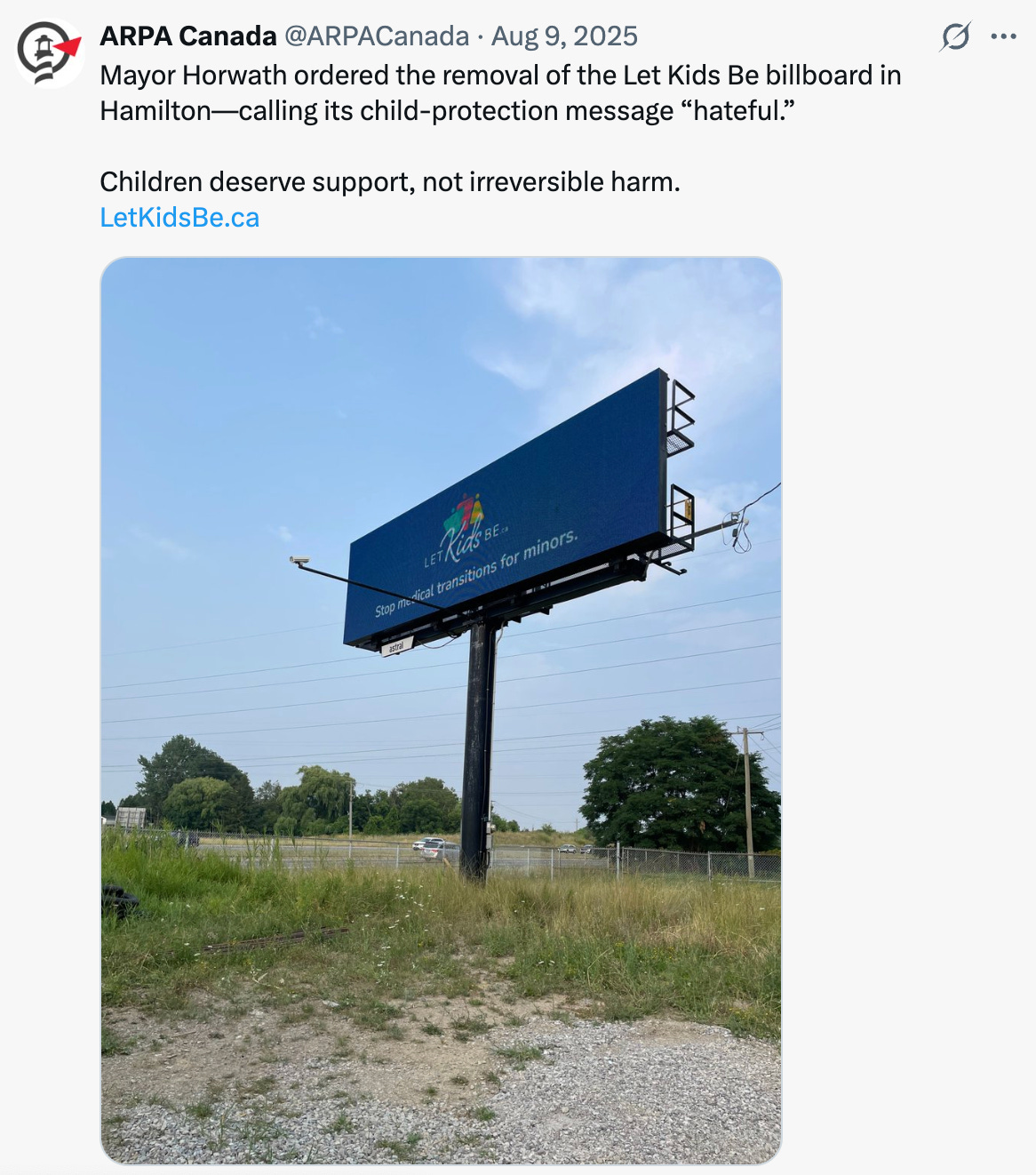
In the summer of 2025, Let Kids Be put up a billboard near a highway in Hamilton, Ontario, that stated, “Stop medical transition for minors.” In response, the city’s mayor, Andrea Horwath, ordered the billboard to be taken down, leading ARPA to challenge the decision. The legal battle is ongoing.
The organization is also defending the Christian Heritage Party in a lawsuit against Hamilton after they tried to run anti-trans ads on the city’s bus shelters.
Against Gay Marriage
In addition to opposing gender-affirming health care and trans rights, ARPA is also against gay marriage. On their website, they link to a 2004 article with the headline “FOUR STUPID ARGUMENTS AGAINST GAY MARRIAGE… AND ONE GOOD ONE!”
In the article, the author writes, “Since God created the institution of Marriage, He gets to decide what it is, and what it isn’t,” and goes on to describe gay marriage as a “poor, sickly imitation the world is proposing.”
And in a 2025 ARPA article titled “TWENTY YEARS OF SAME-SEX MARRIAGE IN CANADA,” they describe gay marriage as a “fall into sin,” and the increase in Canadians’ support for marriage equality as “stark.”
Kayla Preston, Ph.D candidate in the Department of Sociology at the University of Toronto, says that using a pro-family model is a strategy used by far-right groups to mask homophobia. “Instead of saying, ‘We’re anti-LGBTQIA+,’ they’ll say, ‘We’re pro-traditional families. We’re pro-maintaining gender roles,’” she told Uncloseted Media and GAY TIMES.
Celestini says homophobia and opposition to gay marriage is common among many far-right organizations in Canada. “ARPA is one amongst many (Action4Canada, Liberty Coalition Canada, Save Canada, etc.) and they interact, sending out a cohesive message to their followers. Those followers are the electorate, and are also very active politically,” she says. “Religious values can be an umbrella term that erases dogma and denomination from the equation and simply creates a movement.”
Training the Next Generation of Anti-LGBTQ Conservatives
As ARPA continues their lobbying efforts, they’re also training the next generation by running programs in an attempt to provide young Canadians with the “confidence to apply [their] faith wherever God calls [them].” One of their offerings is ARPA Academy, a four-week program based out of Ottawa, Canada’s capital and political epicenter. According to ARPA, participants will “dig into the biblical foundation for political action,” and are encouraged to see the academy as “a stepping stone towards further work in politics or the non-profit sector.”
And in September, ARPA is hosting their Foundations Conference. The conference is designed “to equip thoughtful Christians with a deeper understanding of how faith shapes public life” and will host multiple anti-LGBTQ speakers, including Nancy Pearcey, an evangelical author who claims that “males and females are counterparts to one another. … To embrace a same-sex identity, then, is to contradict that design.”
Proximity to Canada’s Conservative Party
Above all, ARPA’s key goal is to influence Canadian politics. And they’ve already formed relationships with Canadian politicians, where they communicate on issues ranging from justice and law enforcement to health. Conservative Member of Provincial Parliament Sam Oosterhoff spoke at an ARPA event in 2020, and again in 2024. And ARPA Niagara chapter director Dave Broere has donated to Oosterhoff’s campaign.
In May 2025, B.C. Member of the Legislative Assembly (MLA) John Rustad—who, at the time, was the leader of the B.C. Conservatives—attended an ARPA event at the B.C. legislature, along with a dozen other members of his party.
The decision to attend this event drew criticism from Elenore Sturko, a lesbian MLA.
“I was angry, and I felt hurt. … I think a lot about the young people who are growing up right now and are part of the LGBT community. I think that some of the toxicity has never been worse than it is now … and I just felt like, ‘You know what? I have a duty as someone who’s visible to actually stand up for our community,’” Sturko told Uncloseted Media and GAY TIMES.
How Anti-LGBTQ Hate Thrives in Canada
While ARPA’s goals defy what most citizens want—as 75% of Canadians support gay unions—the organization is still allowed to operate as a nonprofit because it is working towards the “advancement of religion.” This means that even though ARPA promotes homophobic and transphobic ideas, they are able to continue their work because they are a protected Christian organization. And while a 2024 report floated the idea of removing religion as a charitable cause, it does not appear the protection is likely to disappear any time soon.
When it comes to the kinds of issues that far-right groups in the U.S. and Canada are concerned with, Celestini says that there isn’t much difference. To her, the most prominent distinction has to do with the way Americans and Canadians think and talk about the far right.
“Most people don’t know that the Proud Boys were started by a Canadian, or that we have a lot of really right-wing extremist groups here in the nation. I think that we’re subtler about it and quieter about it,” she says.
She says being more discreet can come at a cost, however, in that it allows Canadian far-right groups to quietly grow more extreme. “That is problematic because a lot of Christian nationalist groups are actually engaging with American Christian nationalists and extremists and not seeing it as Christian America or Christian Canada, but Christian North America,” she says.
ARPA is getting noticed south of the border. The Alliance Defending Freedom (ADF), one of America’s most powerful Christian legal organizations that has been designated an anti-LGBTQ hate group by the Southern Poverty Law Center, is also concerned with Canada’s Combatting Hate Act. According to an article the ADF released in January, the act demonstrates what happens “once fear leads people to empower the state to impose its view on fundamental matters by labeling dissenting speech as ‘hate.’”
As ARPA gains momentum, Preston says Canadians can equip themselves to identify and respond to far-right rhetoric.
“Be critical of anyone who gives you a very simple answer to a very complex question. So if anyone’s saying, ‘The economy’s bad because of these individual groups or this set of people,’ that’s probably something to be more critical of,” she says.
Celestini suggests combatting extremism by taking an approach rooted in emotional connection and understanding: “When we’re talking to people who are involved in sort of extremist ideas or are on the edge of going into these groups, paying attention to what it is that they’re afraid of is very helpful,” she says. “You need to talk to them on an emotional level and try to find out what that fear is behind the beliefs.”
If objective, nonpartisan, rigorous, LGBTQ-focused journalism is important to you, please consider making a tax-deductible donation in the U.S. through our 501(c)(3) fiscal sponsor, Resource Impact, by clicking this button:
If you’re in Canada and would like to donate, you can make a charitable tax-receipted donation here:

 | A guest post by
|
I would add that Jason Kenney was a regular speaker at ARPA conferences in his days as an MP. So even when Kenney seems like he's being "reasonable" - he's not really.