

Lindsey Graham Was Allegedly This Trans Sex Worker’s Client. Now, She’s Speaking Out [WATCH]
Taylor Snider tells Uncloseted Media about a sexual encounter with the late senator, how she was threatened to remain silent, and what it says about anti-LGBTQ politics on Capitol Hill.


Lindsey Graham, who passed away on July 11 at 71 years old, served in the Senate for 23 years and garnered a reputation for his hawkish views and hardline anti-LGBTQ beliefs.
Years before his death, rumors swirled as allegations surfaced about the Republican senator engaging with male sex workers. The public and the media underscored the hypocrisy of the senator publicly working to roll back LGBTQ rights while allegedly engaging in queer sex behind closed doors.
In this episode of “UNCLOSETED with Spencer Macnaughton,” Taylor Snider, a trans woman and former sex worker, says Graham was a former client. She says Graham’s team threatened her to prevent her from going public in 2020 and calls him the “leader of the circus” when it comes to hypocritical homophobia and transphobia coming from the government. She talks in detail about the sexual exchange between her and Graham, reveals that she’s had other “sitting members of Congress” as clients, and speaks about the broader issue of down-low conservative men in American politics who are “actively working to push anti-LGBT legislation.”
Watch the full interview above or read the transcript here:
Spencer Macnaughton: Hi, everyone! Welcome back to UNCLOSETED with me, Spencer Macnaughton. Today, I’m speaking with Taylor Snider, a trans woman and former sex worker who recently shared her account of an encounter that she says occurred in 2015 with the late Senator Lindsey Graham, a Republican from South Carolina known for his close allyship to President Donald Trump and his support for anti-LGBTQ policies. Since his death, multiple sex workers, including Snider, have come forward. Today, she’s here to share her story. Taylor, thanks so much for speaking with me and Uncloseted Media today.
Taylor Snider: Of course, thanks for having me on. I really appreciate it.
SM: You spoke out shortly after Senator Lindsey Graham passed away on July 11th. First, tell me why you decided to speak out at this time.
TS: Of course. When I found out the senator passed away, I was on vacation with my family. And I woke up one morning—I think it was the day after he passed away—and I just opened up my Instagram feed to a flurry of posts regarding the senator. The posts that really inspired me to speak about or just talk about this late senator this time around was there was another trans woman, her name’s Jamie, and she had shared her story. And so when she was talking about her experience, I was like, “I have a lot to input here.” Because this is not the first time I’ve actually talked about this. I’ve talked about this at least five or six times over the last 11 years. And every other time that I have tried to bring it up, I’ve either been silenced, shut down or no one really takes it seriously and they just think I’m lying or I’m making something up. But now that the late senator has passed away, it’s like now everyone cares. So that’s why I decided to come forward because everyone else was speaking about it and he passed away, and I really didn’t see no imminent threat anymore.
The Encounter
SM: For our viewers who haven’t heard anything about your story, can you walk us through in granular detail how Lindsey Graham found you and how you guys connected for the encounter? I believe it was in 2015?
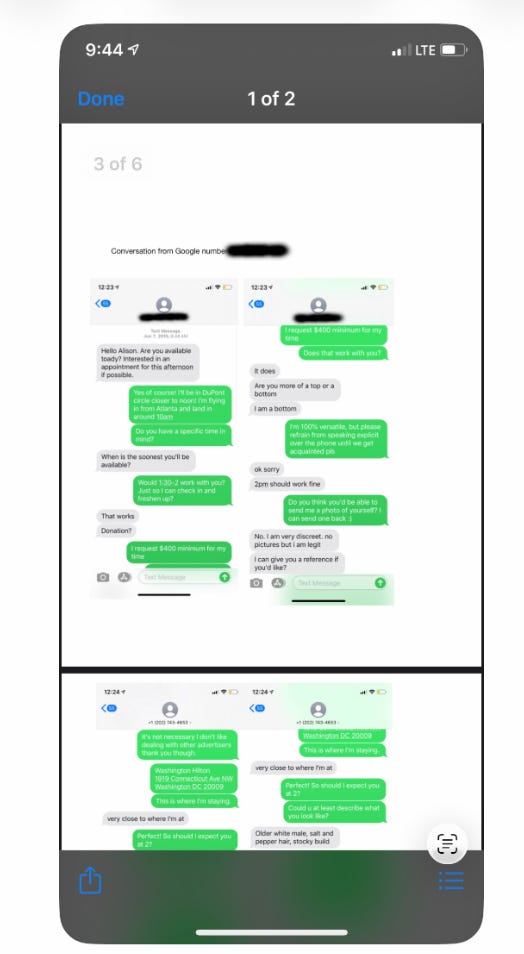
TS: It was in 2015, yes. So it was the very first time that I had ever visited Washington, D.C., and I posted an advertisement on an escort website. The late senator got in contact with me, he contacted me from a Google voice number. It’s not very uncommon to get texts or calls from people like that and for them to be discreet. So he texted me, we had some back and forth chat, we made a plan. I was staying at the Washington Hilton in Dupont Circle. When he arrived to the hotel, everything was really normal to me. It was very standard, nothing stood out. So he came in, nothing raised a red flag, he was in and out within maybe like 30, 35 minutes and then he went about his merry way. You know, I always wrap up an encounter with someone and I basically would always say, like, small talk, “What else do you have going on for today?” or “Anything exciting?” And he just said, “No, I just gotta go back to work,” very casual about it. And I didn’t think anything of it. I just thought he was just some horny old guy.
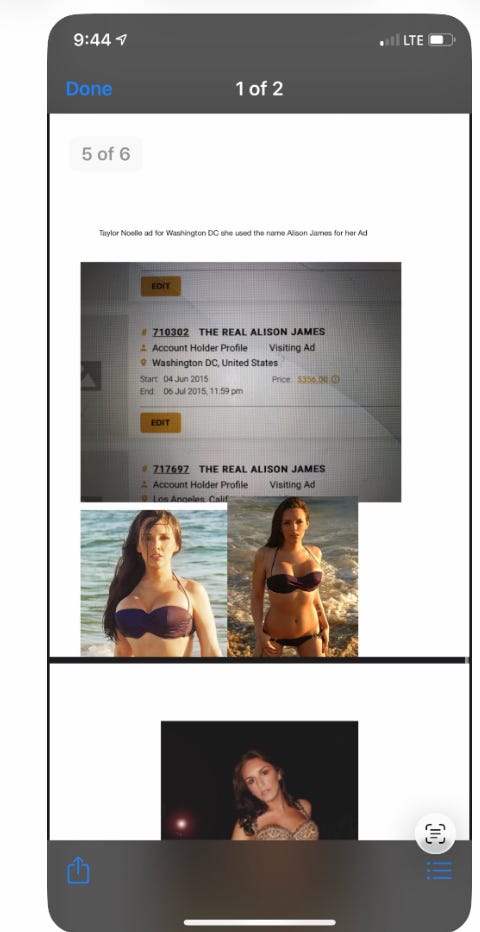
SM: What do you think about your advertisement on Eros drew Lindsey Graham to you? You shared some text messages with the number that he was allegedly texting you from and in those texts, he allegedly asked you, “Are you a top or a bottom?” and he told you he was a bottom before you guys met. So is it fair that he was looking to bottom in his pursuit for an encounter with a sex worker?
TS: Absolutely. So I’m very much an open book, and yeah. I topped Lindsey Graham down, and I’m sorry if that sounds vulgar. But like, it just is what it is.
SM: And during this, because I think getting to this accountability beat, the Trump administration has slashed an unprecedented amount of HIV prevention funding, STI related funding, LGBTQ healthcare funding. Did he talk about safe sex? Did he ask for a condom to be worn? Did he mention if he was on PrEP, if you were on PrEP, did any of that happen or no?
TS: Of course one was, yeah, one was absolutely worn. That’s—
SM: No, I just know, because PrEP was widely available, all that kind thing. You know, some people…
TS: Again, this was back in 2015 and this was also an experience that was very normal. And when it comes to normal, normal means protection. It feels like you’re reading from a script almost. For a sex worker, a lot of these experiences are quite repetitive.
SM: OK, so relatively normal encounter, you’re not probably thinking too much of it.
TS: No.
SM: He winds up paying you $400. How did he give you that?
TS: He gave it to me in cash. Back in 2015, you know, the standards were much different for sex workers, especially trans sex workers. So that was very much the norm, just getting $400 in exchange for services like that.
SM: Take us to the moment where you realize, “Oh, wow, this is a politician. This is Lindsey Graham.”
TS: So I was traveling from Washington, D.C., to New York, and I was with a girlfriend at the time. We were at the bar and they had CNN on. I’m watching this TV and all of the sudden, he pops his little face up on the TV on CNN. And I see a senator, Lindsey Graham, Republican. And it’s talking about the Tea Party. This was like maybe a week and a half, maybe a week after seeing me, and he’s talking about running for president in the Tea Party. And so I’m just like, “OK, he’s running for president.” I really didn’t think much of it. I very much value discretion and keeping things professional, so I just kinda let it lie. I’ve seen a lot of celebrities and high profile people without even signing an NDA. And I can talk about them all day long, but I’m not going to because there’s a trust that is built at a certain point. And so I kind of let it lie. I didn’t think anything of it. But then as time continued to go on after that, months and years preceding that, it was when I started to learn more about his policies and his principles and the things that he believed in and the things that he was preaching, and that’s when he was starting to push more for the anti-trans bathroom laws in North Carolina. He’s a big reason why you have to sign an affidavit now in order to even get a passport with an “F” on it. Like when I had to renew my passport, I had to sign an affidavit that acknowledged that I was not genetically born a woman because of things that he has cosigned. Same thing if we go to Florida. If I go to Florida, I technically have to use the men’s room. So in situations like that, I was like, “Wow, you’re a really big hypocrite,” and then seeing all the other stuff that Sean Harding and all these other people were posting at the time, that’s what made me get the gall to move forward and try to talk about my story.
‘It’s About Accountability’
SM: And I want to read, just for our viewers, a few things from Lindsey Graham’s track record on LGBTQ issues, just so they’re fully aware and then get you to speak more on this.
TS: Of course.
SM: So Lindsey Graham, he does indeed have a pretty brutal track record on LGBTQ issues. In 2006, he voted in support of a constitutional amendment that would have restricted marriage to between one man and one woman. After gay marriage became legal in 2015, he said, “I am a proud defender of traditional marriage.” And in 2022, he told CNN he would oppose the Respect for Marriage Act and later reiterated that states should decide the issue of marriage. As you know, he’s also opposed transgender rights and supported restrictions on gender affirming care, on trans athletes, on limits to bathroom access and on other accommodations. And up until his death, he was one of Trump’s closest allies who has waged a relentless and unprecedented war against the trans community. Tell me. It’s been 11 years, right? As you kept seeing these things come forward with Lindsey Graham, you’re a trans woman and you know the hypocrisy having had that experience. How does that affect you on an emotional, personal level?
TS: I think being a trans woman and being a sex worker as well has given me the ability to possess an insane amount of resilience and an insane of amount of numbing as well, as fucked up as that might sound. But it’s so true. I’ve gone throughout a majority of my life being ignored, being dismissed, being discounted, being not taken seriously. So when I hear things like this and when I experience things like this, it’s like, “OK, another day.” So it’s refreshing to see people have a little bit of interest these days, especially now. But also it’s like, how long is this going to last? Are you actually going to continue to listen?
SM: And some people may say, “Why do you come out? What’s the point of this? He’s passed on,” that kind of thing. Before we went on camera, you said it’s all about accountability. Tell me more about what you mean by that.
TS: It is about accountability. It’s so funny because a couple weeks before the senator passed away, I was actually talking quite a bit about not having much tolerance for conservative men anymore. And there was another person that was recently outed by another trans woman who was a political streamer; his name was Chud the Builder. There was a woman, a trans woman, who basically outed him and he was a very rampant Trump supporter and it stirred up a conversation. I was like, you know what, I’m over entertaining these down-low conservative people. I’m like, you’re gonna want to lay in bed with me in private, but then vote against my rights in public? Make it make sense. That’s absolutely asinine. Nobody cares what your preferences are. Nobody cares what you’re attracted to. Where the line in the sand is drawn is when you are actively working to push anti-LGBT legislation when you’re over in private on your hands and knees with us. That’s a problem. That’s a problem entirely. I’ll say right now, like I know a lot of people who work in politics that are not Republican that see me all the time. But the thing about them, they’re not voting against my rights as a human.
SM: Right, and that’s the big difference for you. If this were a politician who was voting in favor of trans rights, you wouldn’t be coming forward and, frankly, we wouldn’t be interviewing you because it’s not newsworthy at that point.
TS: Exactly.
The Threat
SM: I want to touch on that a little bit more, but let’s start a little bit more at that moment in 2020 because this picked up big headlines. So you referenced it earlier that in 2020, adult video performer Sean Harding wrote on Twitter that, quote, “There is a homophobic Republican senator who is no better than Trump who keeps passing legislation that is damaging to the LGBT and minority communities. Every sex worker I know has been hired by this man. Wondering if enough of us spoke out if that could get him out of office.” A few days later another anonymous sex worker shared similar allegations but very shortly after that, everything kind of went away. There were lawyers actually posting on Twitter that “I’ll offer you pro bono services” to sex workers who wanted to come and essentially try Lindsey Graham. This made national headlines. Tell me about your involvement in this and why you think it ultimately went away?
TS: Well that wasn’t my involvement. I didn’t have the lawyers, I wasn’t directly speaking with Sean Harding or any of the other sex workers either. I was seeing all this stuff and so I had reached out to someone else who—so me being a trans woman, it’s a very small world in the trans community. And so I have other friends who, back in the day, back in 2015, they had sold their stories regarding sleeping with celebrities. Very salacious-esque type stories, not really like situations like this. It was like, you know, ooh, celebrity husband.
SM: Tabloid journalism kind of thing.

TS: Exactly. So the woman that helped facilitate them getting their stories out there was also helping me with Senator Lindsey Graham. And we were trying to get an account of all of my stuff. This is when I was digging for the text messages. This is when I was making phone calls to the Washington Hilton trying to see if I could gain surveillance footage of the late senator entering the hotel at the agreed time that he was supposed to come. So the problem with that was, when this was all happening, it was COVID, it was 2020. All the hotels were shut down. And so trying to call a hotel, trying to speak with security and gain access to 5-year-old surveillance footage was near impossible. So it didn’t matter. I was able to pull what we had and we were able to get a really ironclad timeline of the late senator being in D.C. at the exact same time as I was. And I had my text messages. That’s what I had. So we got everything together and then I got a phone call before I’m about to go on a flight, like about a week before we were about to really start to push this story out to the masses. And then when that happened, I still boarded the plane even though I was as nervous as ever. And I got to Seattle, I landed, I went right to my room, took all my ads down, locked my door and did not see anyone new. I just kept a really low profile. I can only assume that I wasn’t the only one who was threatened or silenced or intimidated, because after that happened, like you said, nothing ever really came of it. And it was a big conversation that was being had and it just kind of went radio silent.
SM: Mm-hmm.
TS: I’m assuming it was for a situation very similar to what I experienced.
SM: And it’s a blocked caller and they’re calling you saying what exactly? And what reason do you have to believe it was related to Lindsey Graham?
TS: Well, it was the only thing that was pertinent in my life that I would have been threatened for, one. And then two, the person on the other line said, “If you move forward with your story, watch your back.” What story? The only one I’m actually talking about of relevance was that one, so. And at the time, the woman who was helping me facilitate, she was already putting her feelers out there. So I can only assume that someone else, working in media, picked up on the story and relayed the information to whoever was working with Lindsey Graham or Lindsey Graham himself. And that is what inspired a phone call to me.
SM: Did you talk to the person or did they literally just pick up, threaten and hang up?
TS: Very that.
SM: Very that, OK. Who was your person trying to sell the story to and how much did they think you could have gotten for it?
TS: Her name was Gina. She was going to start the bidding at around 50,000, and she was going to continue to push for more, and that was just based on one media outlet. Like I said, one of the friends that she helped facilitate sell a story for, with the earnings that my friend made, she was able to buy a home.
SM: Wow, and where’d they sell that story to?
TS: TMZ, everywhere. My friend was on the cover of Us Weekly, like it was all over the place.
The Bigger Picture
SM: Wow! Interesting. I want to talk a little bit more broadly about this conversation around accountability. You might have seen that on a recent podcast episode, the “I’ve Had It” podcast, Hunter Biden said, quote, “Everybody knows there’s this closeted gay mafia, largely Republican, that exists in Washington, D.C., and everybody knows every single one of them who is gay.” What do you think about this? Is there a broader picture here beyond Lindsey Graham in politics?
TS: I think it’s even more broad than just politics. I think it’s a worldwide issue. I absolutely do believe that it is an issue amongst conservatives, amongst Republicans and amongst people in the church and just in society in general. I feel like society has been conditioned to believe that there’s only one way to live. And then people fall victim to that, and they get trapped in this mentality. And it’s unfortunate because it just ruins a lot of lives too. So I absolutely think that there is an issue with just being in the closet and projecting your own insecurities onto an entire group of people, absolutely. I mean some of the biggest homophobes and some of the biggest people who do a hate crime are undercover, down-low homosexuals.
SM: Right. Have you had clients who are other Republican politicians or conservative influencers, people in this space?
TS: I mean, of course. I’ve seen a multitude of people. I’ve seen a few other people that have been sitting members of Congress that were a little bit more conservative leaning, but like I said, I’m not ever going to out them because when it comes to oppressing a people, Senator Lindsey Graham takes the cake.
SM: But you’ve seen other Republican sitting members of Congress?
TS: Yeah, but I’m not gonna touch on that much more.
SM: No, that’s understood. But I think it’s interesting to know that. Are there any kind of consistent themes in what they like, how they engage with you, when there are these conservative folks.
TS: The Senator Lindsey Graham experience, that’s not the norm. Like even though there were no red flags raised, that’s not the norm. Most people just want to have a relaxed experience and most men want to assert their manliness, their dominance. So yeah, if you get my drift.
SM: Totally. And I have to ask, you know, if you have been with other sitting members of Congress who are Republican, who are part of that party right now in America, are likely preaching transphobia, why won’t you out them right now?
TS: Because Senator Lindsey Graham is the leader of the circus. So even though he’s dead now, like, no, this guy takes the cake. And if Trump were the one seeing me, you know, he’d take the cake. So at a certain point it’s like, they’re not the ones leading the conversation here. Senator Lindsey Graham was.
SM: Is there also, I would imagine, an element of risk to you outing people who are still alive too, yes?
TS: Sure, these people aren’t dead. Absolutely, no, yeah, I’m not gonna risk that. I’m not gonna risk the livelihood of my own business. But at the end of the day, I’m not going to risk what I’ve done for myself to go ahead and out other people that are still living, that aren’t even leading the conversation on things like this.
SM: What else can we do? Because I’m thinking about that word accountability that you mentioned earlier, right? Like, there’s obviously more Lindsey Grahams out there who are doing similar things and really rolling back the lives of trans people in America right now, doing things to make their lives almost unlivable in certain instances.
TS: I think about it like this: I have had conversations with clients in the past who are more conservative, more Republican, very proud about it too. And I just sit there and I talk with them. Have a real genuine conversation with someone, especially if you’re someone like me. If you’re trans, if you’re a queer person, have a conversation with the people that are choosing to lay with you in private but vote against you in public. Most people are actually quite on board. I mean, there are even Log Cabin Republicans. So the reason why there’s so many people like this is because I feel like they’re more fiscally conservative. They’re trying to protect their own interests. And so I can’t sit there and say that I don’t understand that either. But also, there is a moral point where, like, are you really going to jeopardize an entire group of people’s rights and quality of life just so that you can save a couple bucks on your taxes? Kiss my ass.
SM: This is all super interesting. We did an investigation into the connection between Republicans and trans porn, and we found that Mark Robins—I want to know why you’re laughing when I get to the end of this question.
TS: Because it’s true! I mean, it’s just, the porn is just out of control.
SM: So we found that Mark Robinson, who was a gubernatorial candidate to be the governor of North Carolina. And he has compared LGBTQ people to maggots, flies and filth. And it was discovered by CNN that he does have an affinity for trans porn.
TS: Oh I love that.
SM: And in 2022, data from lawsuit.org found that searches for transgender porn are most popular in red states like Texas, Georgia and Kentucky, all of which are predominately Republican and among the most active agents in the recent wave of anti-trans legislation. It sounds like this does not surprise you.
TS: No, of course not. Some of my best clients were from red states.
SM: What is behind that? Like such intense transphobia and an affinity, a romantic interest or a sexual interest in things like trans porn.
TS: They’re a product of their own environment. I mean, take a look around. When you have your entire society shoving the Bible down your throat, conservative family principles down your throat and that’s just perceived as the norm. I think all humans have this desire to just be normal—
SM: And fit in.
TS: And fit in, right. As simple as that sounds, I feel like every single human has that desire and that craving. And so when you live in places like Texas, Mississippi, Alabama, Florida, Tennessee, where these narratives are pushed like normal conversation. When you are a little different, it just makes it that much more difficult and that much more of a struggle. Who wants to have a life full of struggle? I certainly didn’t want a life full of struggle, but in order to live in my truth, I had to just walk through the flames. Unfortunately, most people just don’t have the panache to live in their truth and that’s a shame. So there’s going to be a lot of unhappy people out there.
SM: Mm-hmm. Well, and it’s interesting. I mean, Lindsey Graham, he identified as a Southern Baptist and even spoke at a Baptist church a week before his death. And as you probably know, just as recently as last year, a group of Southern Baptist delegates called for the reversal of the Supreme Court’s ruling on same-sex marriage. And I mean I don’t have to tell you what the Southern Baptist church has to say about trans folks. Does any part of you have empathy for Lindsey Graham and how closeted he must have been.
TS: It’d be so horrible for me to not have a little bit of empathy. I mean, just based on watching him over these last 11 years since I saw him, it’s really difficult to not have a bit of compassion for someone that is just, like really going through it. I’m gonna sit here and say I can’t even imagine what that’s gotta be like because he was already heavy into politics before he met me. Who’s to say that he maybe didn’t discover things about himself after he had established his career? It’s like, what do you do in circumstances like that? That’s gotta be really difficult. And so that’s why I’m trying my best not to be so judgmental and so salacious with this story. But also, there does still need to be accountability.
Trans Rights in Danger
SM: As a trans woman right now, you know, I have trans friends who have moved. I just had a trans friend who moved to Berlin with her wife because it just got so dangerous, she said, to live [here]. Can you tell me what the existence in America is like for trans people right now from your perspective as a trans woman? And how has it changed in Trump 2.0?
TS: Well, let me tell you this first, my perspective as a trans woman is going to be substantially different from a majority of my other trans sisters and brothers. So first of all, because one, I’m privileged as absolute hell. I’m pretty and I’m white. Those are three things that a majority of trans people do not have. But for the majority of the trans people that do live here, yeah, I can’t possibly imagine navigating the world right now.
SM: How has life changed because of the decisions American politicians have made since Trump 2.0?
TS: Um, well, I mean, even if there were no laws being changed, even if trans people were not in politics and written in bills, just a simple discourse amongst people in general, like that right there is more damaging than any law that will ever be put into effect. I think with all of this publicity that the trans community is getting, it opens us up for being attacked more. You know, you look at people like Erika Kirk and Turning Point, they’re calling on their people to start a war with us in some weird type of way. And so that’s really intimidating. And it makes me feel like, Oh my gosh, like, do I need to, you know, strap up even more? Like I own several guns, so it’s like, do I need to get a flamethrower too? Like, what else do I need to do? I don’t like having to navigate that. It’s all, it’s not really so much the laws. It’s really people feeling like they’re entitled to get away with treating people like us like garbage, just because people in power are having an opinion about us. That’s what’s scary, because at the end of the day, these are the people that we’re existing with on a day-to-day basis, walking in the streets with these people. At any moment, who knows, there’s a psycho that could just come up and just, you know.
SM: And obviously also, you know, the language and the rhetoric, a lot of it is coming from the Trump administration. I mean, he said so many times in his campaign and on the campaign trail, we need to quote, “get rid of transgender insanity,” whatever that means, right? And recently in his counterterrorism strategy, he actually, he didn’t reference white supremacy or far-right extremism as a terrorist threat, but he did reference radical pro-transgender anarchists, whatever that means. I mean, that must be scary for you. As we know, there is no credible evidence that shows that trans people are disproportionately likely to commit terrorist attacks, but they’re misinforming the public by including this in a counterterrorism strategy. I think it’s just breathtaking to even say it, to be honest.
TS: I’m very proud to be an American. I still believe in all the good that can come out of this country. You know, I still think that there is opportunity to correct a lot of things here. And I think if we actually sit and listen to each other and take the time to actually have some of these conversations and actually listen with open ears and open minds and open hearts, then maybe something will actually change.
SM: What would you say if Lindsey Graham were still here and you could say something to him, what would you want to say to him?
TS: Sending you a hug, boo.
SM: Amen. Last follow-up question. We’re in a time, and this is one of the reasons I started Uncloseted Media to be honest, because I saw a problem. Upwards of 40% of LGBTQ kids seriously considered suicide in the last year. That number is even higher for trans kids, right? So to the congresspeople, or the politicians who may be going to vote in one way and then doing something completely hypocritical behind closed doors. Do you have any message for them, for the people who are still here doing this?
TS: Take a look in the mirror and really think about what it is you’re doing. Because it’s not making much sense. Like really do some soul searching. You need help. I suggest therapy too.
SM: Some critics may argue that you’re only speaking out now because he’s no longer here to counterargue your story and that this could be a good opportunity to maybe sell the story or even write a book. Who knows? What would you say to those kinds of critics?
TS: I mean, you know, no, I’m not really looking for opportunity. The motive from the jump was always accountability. You know, like I said, I really don’t need the money. Yeah, no. This is really all about accountability.
SM: I feel like that’s a good place to leave it off. Taylor Snider, thank you so much for speaking with me and Uncloseted Media today.
TS: Yes, thank you so much for having me, I appreciate it.
SM: And if you liked that episode and want more of our investigative journalism, subscribe to unclosetedmedia.com or find us wherever you get your podcasts.
If objective, nonpartisan, rigorous, LGBTQ-focused journalism is important to you, please consider making a tax-deductible donation in the U.S. through our 501(c)(3) fiscal sponsor, Resource Impact, by clicking this button:

 | A guest post by
|
I'm totally not surprised. I tried a forum where cis people can explicitly meet trans people. I already expected being fetishised, so it was more an experiment without big expectations.
However I have never gotten *that* amount of transphobia as from people who want to have sex with us *because* we are trans.
Multiple times I was told people were "more tolerant" in the 80s and that "having to respect us *under the law*" was now going too far. They literally complained they can't discriminate against me while looking to hook up with me. You can't make this up ... These people don't even *see* the hypocrisy in that.