

Matt Bernstein, aka Mattxiv, Is the Next Generation of Progressive Social Commentary [WATCH]
The queer Gen Z internet sensation talks misinformation, LGBTQ issues under Trump and the impact billionaires are having on mainstream media.


UNCLOSETED, with Spencer Macnaughton is a new podcast by Uncloseted Media, an investigative LGBTQ-focused nonprofit news publication. Follow and subscribe wherever you get your podcasts. YouTube // Spotify // Apple
Matt Bernstein, also known as Mattxiv on Instagram, where he boasts 2.2 million followers, is one of the most influential internet voices for young queer progressives in the U.S. Through vertical videos, uniquely curated social posts and a podcast called “A Bit Fruity,” Bernstein tackles the most pressing—and controversial—issues of our time, but presents them in an accessible and bite-sized way that meets the moment of how consumers want to receive information in 2026.
In this episode of “UNCLOSETED, with Spencer Macnaughton,” Spencer sits down with Bernstein to talk about why far-right podcasters are dominating the internet, the state of the Democratic party on trans issues and why “nobody [his] age cares about legacy media.”
Watch the video or read the full transcript below.
Spencer Macnaughton: Hi everyone, welcome back to UNCLOSETED with me, Spencer Macnaughton. Today I’m here with Matt Bernstein. He got his start posting rainbow-colored makeup looks with political messaging on socials. Since then, Out Magazine has called him one of social media’s most prominent political voices. With 2.2 million followers on Instagram, Matt doesn’t mince words as he speaks about his support for Zohran Mamdani, his critiques of both Republicans and establishment Democrats, and his unrelenting advocacy for the queer and trans community. Matt, thanks so much for speaking with me and Uncloseted Media today.
Matt Bernstein: Thank you so much for having me. It’s a pleasure.
SM: So, for the very few listeners who have never heard of you, who are you and what do you do?
MB: Man, well, my name’s Matt. I am 27. I just say that I make a podcast called “A Bit Fruity” where I do political and cultural commentary. For much longer than that, I have been on Instagram, Twitter, just kind of like a gay about the internet. I became, over the last number of years, really just increasingly politicized, and I kind of just run my mouth in a way that I try to make constructive, especially during these highly turbulent times.
SM: For backstory for the folks there: You went to NYU, you studied marketing and photography, and I believe you started posting makeup looks with political messaging. So, tell me how you went from those initial looks to where you are today. Was there a moment where it all popped off for you, or was it a slow burn? Tell me about the kind of progression.
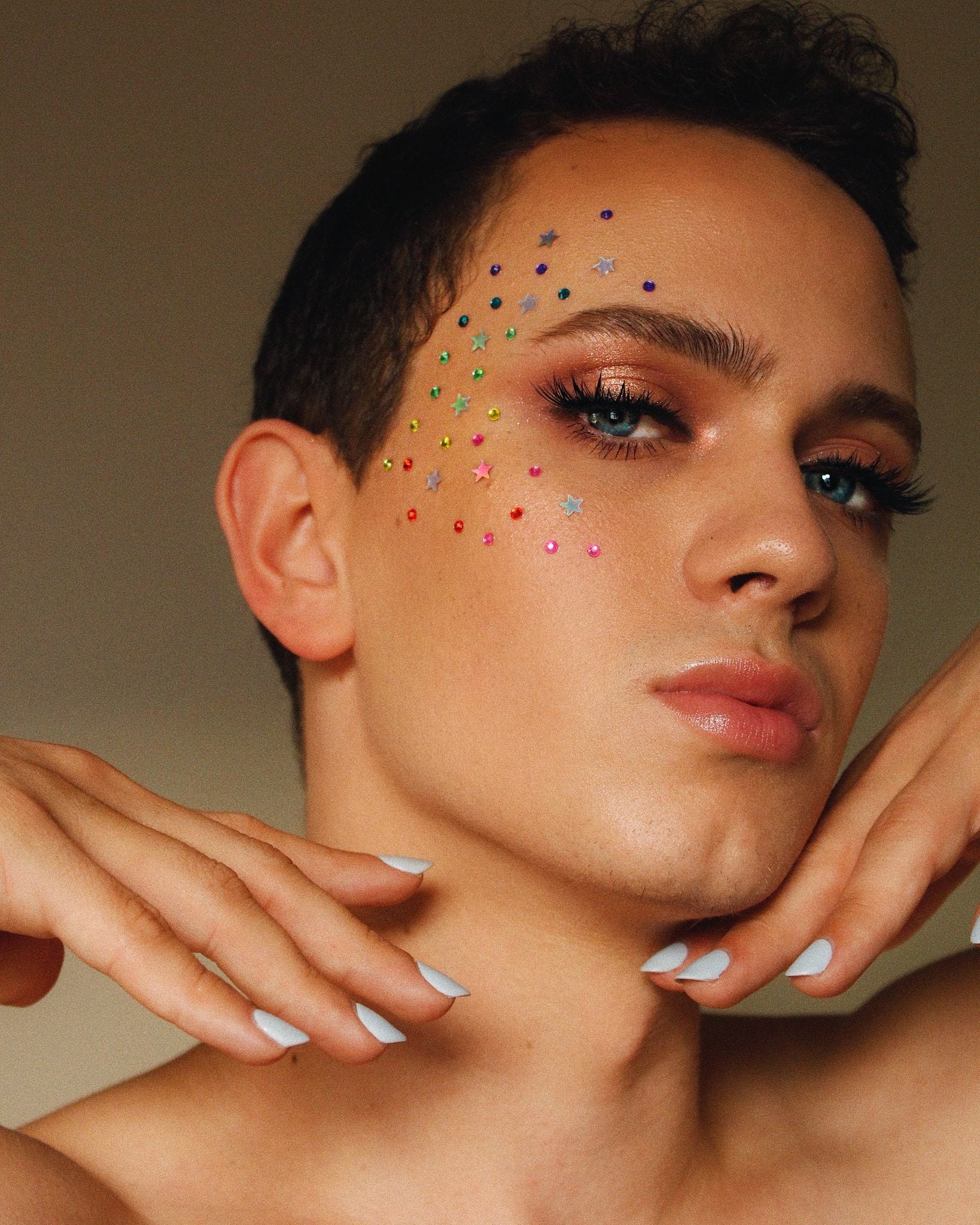
MB: Yeah, it really happened over time. I think, you know, there’s a portion of my audience online that has followed me since the makeup days. Now I reach a broader audience. I think I reach also older people who just are into talking about politics and who, you know, might not have cared about it when it was coming to them in the form of these highly aestheticized makeup looks. But it’s always been a slow crawl in terms of adult professional life. This is the only thing I’ve ever done because by the time I finished college, and I did finish college, it was a full-time job.
SM: Obviously, you don’t come from a professional journalistic background, but the videos you come up with are really smart, really poignant and really topical. What goes into your brain when you’re like, “This is really important and something the world needs to see,” and then how do you kind of go about constructing the story, really? Because what you’re doing is storytelling.
MB: What I do is try to capture people’s political imaginations through storytelling, whether that be through celebrities, whether that be through these human interest stories. That’s one of the beautiful things about doing this as a job that I’m so grateful for, is I get to just think, “What am I totally captured by? What can I not stop thinking about?” Whether it’s like a right-wing grifter or, you know, Israel’s co-opting of Jewish identity to use as a shield behind which they can commit genocide. Like these are things that I never shut up about in my real life when the cameras aren’t on and when the phones aren’t in front of me. I just then try to channel those ideas and opinions that I really have, that take over my brain, into something that I can share.
SM: I find it interesting, though, because you said this is what you talk about when the cameras are on or are not on, right? But a lot of people don’t feel that impassioned to make it their entire job. Have you always been that way from when you were like a little kid? Like, have you always had that kind of fire?
MB: Yes, I would say. I mean, it wasn’t, you know, like, as a 10-year-old, I didn’t have that fire about like, Israel, for example. But I have always been like a litigator for sure, in my personality, and my parents used to tell me growing up, they were like, “You need to be a lawyer because you never stop arguing,” which I think drove them crazy sometimes. And also, I did not want to go to law school. So now I do this instead.
SM: We’re living in a country right now where roughly 40% of LGBTQ kids seriously considered suicide in the last year, right? I know you’ve talked about wanting to reach people in the “Bible Belt,” wanting to reach people in red states. Like when you’re producing your work, how does that come into play with what you put out there and how?
MB: As I’ve become more of a political person, like yes, everything’s political, but like someone who really talks about politics head-on all the time, I am very passionate about trying to expose in this current moment, like, why transphobia has just become this issue that’s stuck for the right. And so now I try to focus, I think a lot of my energy on being truthful about what’s actually going on, so people don’t feel shy about standing up for it forcefully.
SM: And I think your voice is super important to the conversation because the truth is far-right and anti-LGBTQ influencers dominate on socials and in the podcast ring. I want to read you a few stats, and then I want to get your—I’m actually really curious why you think this is. So 6 of the 10 podcasts in the U.S. on Spotify come from right-wing perspectives, and right-leaning online shows get nearly five times as many viewers as left-leaning ones. These include Joe Rogan, who is number one on Spotify and has falsely said that trans people are perverts who commit the majority of mass shootings. We also have Tucker Carlson, number four in the U.S., who’s claimed that gender-affirming health care allows adults to “basically molest and abuse children.” And then we have Candice Owens at number 10, who has called homosexuality a social contagion and has blamed gay men for pedophilia in the church. Why are these the top 10?1
MB: I mean, wow, there’s a lot of reasons. I just, those quotes strung together, it’s really…
SM: It’s shocking.
MB: Yeah. It’s really wild. It’s a multi-pronged issue. One, of course, and I talk about this a lot, is that there is an ecosystem propped up on corporate, institutional billionaire support that creates all of these podcasts, all of these right-wing media celebrities. They are funded. They do college campus, essentially recruitment, through things like Turning Point USA, PragerU, they will go and scout talent and pick people out and give them microphones and give them studios and give them advertising deals, and make it a sustainable career, if these young on-camera talent are willing to say the right lines, that of course supports power, that supports billionaires. Because really wealthy people in this country, and we saw this exposed with for example, a lot of the Epstein stuff, they love right-wing culture warrior fear-mongering bullshit, because it protects them from any sort of widespread discussion about class inequality, which is what they are, of course, very afraid of. Like these people don’t have to do Patreon, these people don’t have to do crowdsourcing. But it’s like, if you want to be a right-wing podcaster and you are beautiful and charismatic and can say the right lines, because the opinions you’re willing to espouse are those that flatter power, power will reward you for that. But it’s also, it’s unchallenging. Yes, unchallenging to power, but also unchallenging to a lot of people’s own internal biases and privileges and prejudices. Like if you are uncomfortable with trans people, for example, for any reason, but like, let’s say maybe it forces you to ask questions about your own relationship to your gender or stuff like that. It’s very comforting to have someone tell you, “You’re right, trans people are bad, you shouldn’t be thinking about these things, and you should hate them and here’s why.” It’s just hard. It’s hard. It’s hard to be a principled person who wants equality for all people all the time. There’s a lot of things that make that a hard thing to advocate for, and it’s uncomfortable.
SM: No, I mean, what you say is 100% right, because if you look at the stats, the money behind far-right podcasters completely eclipses anything close to what is, on the money behind people on the other side, if you will. And I saw one of your videos, the other, I think it was like last week or something like that. And we had done an article about how the far-right chose Riley Gaines for the sports debate. And she was this, you know, a conventionally attractive woman who tied for fifth place in a race where she competed against a trans athlete, and since then she’s appeared on Fox News 29 times and been hired as an official spokesperson for the Independent Women’s Forum, a far-right organization known for anti-trans activism. Since that infamous race, she sued the NCAA, headlined nationwide speaking tours, and launched The Riley Gaines Center at the Leadership Institute, which is affiliated with The Heritage Foundation, who wrote Project 2025, right? So, I think what we try and do is unpack all those ecosystems and those orbits, and you try and do that as well. But like why—it’s not that hard, spoiler, to actually report on this and figure this out, but so few mainstream outlets actually talk about her in that way. They’ll actually just have her on as an advocate for women’s rights. Why do you think people are so afraid to actually go there when it’s not like the reporting is that hard?
MB: In my opinion, when it comes to these mainstream news outlets, like the ones we consider to be left of center, whether it’s CNN or The New York Times, they don’t care that much about queer people either. And you’re right, it is easy to figure out every aspect of Riley Gaines’ complete and total grift. I mean, given how famous she is and how much direct access she has to the president of the United States, and the fact that there are laws in multiple states named after her that target trans women. Like, someone who tied for fifth place in a college race four years ago couldn’t get over it, didn’t even care that much initially, but was incentivized to become more cruel through an influx of income from right-wing media outlets like Fox News, Fox Sports, et cetera. They don’t report on that. And if anything, if Riley Gaines gets referenced in these left-of-center mainstream news outlets, they’re just like, “Oh, you know, advocate for women’s sports,” or something. And it’s a real shame because people deserve that bigger story. But I think a lot of it comes down to these outlets just don’t care that much about trans people. And so new media has to do that work.
SM: And want to circle back to your answer. You were saying, you made a good point that far-right podcasters, influencers, they have way more money behind them. Like “they don’t need to go on Patreon,” kind of thing. Why do you think there isn’t similar money in the left sphere?
MB: Well, because where is that money gonna come from? The leftist billionaires? Point to them. There aren’t too many. You know, there’s a way to make a lot of corporate money as maybe, a mainstream liberal in new media, like a sort of what we would say, like “DNC Darling.” But ultimately, two things: One, that requires espousing the most sort of “milk toast” positions that are completely unpopular today. Like you know, those people will never talk about the genocide in Gaza. Those people won’t talk about trans issues too forcefully, they won’t talk about taxing billionaires, they won’t talk about the ways that all of these issues intersect. It’s just kind of the types of people that are very safe for, you know, the Democratic Party donors to invest in, and they don’t get much of an organic audience, which is why I can’t even really name a good example of those types of people off the top of my head. But they’re on YouTube.
SM: People in the U.S., especially right now, don’t trust traditional media, I think, for a variety of reasons, but, you know, only 28% of Gen Z adults say they trust mass media, and 37% of adults under 30 say they actually get their news from influencers. And as somebody who used to work at 60 Minutes, which is right over there—
MB: Yeah, rest in peace, Bari Weiss.
SM: Well, yeah, exactly. I really appreciated the integrity. I did think it was a great place to work and was amazing journalistically. But I do think it’s a shame what’s happening with Bari Weiss there and with the people being put in charge. What do you think is the future for legacy media as more of these billionaires start putting people in positions of power that are essentially just self-fulfilling prophecies?
MB: Well, I think it’s falling apart. I mean, that’s not even really an opinion. We have the numbers to back that up. I think, you know, all of CBS’ programming, for example, has like, the viewership has fallen since Bari Weiss has taken over. And I think Bari Weiss is a great example of just, like, institutional corporate media really overplaying its hand in how propagandized they think the public is actually willing to be. You know, CBS, now pandering to Trump with and owned by Paramount Skydance, is trying to appease power to the extent that they put in Bari Weiss, someone who nobody organically cares about, and someone who is a far-right anti-trans pro-Israel fanatic. And she’s, I think about how she was in the lead up to her becoming the head of CBS, she was doing this panel where she was talking about how “The young people, they don’t want these radicalized voices anymore. They don’t want people like Hasan Piker. They want everyone to come back to normal, to the center, like people like Alan Dershowitz.” And it was such an amazing moment of just demonstrating how out of touch these people are that Bari Weiss sincerely believes, or is pretending to believe, that the youths yearn to hear more from Alan Dershowitz. It is so unbelievable. But look, their viewership is plummeting because nobody cares.
SM: And you think, you’re saying nobody cares, and you think the reason she got that gig, editor in chief of CBS News, is because she’s just the mouthpiece that they want?
MB: Of course, of course, and look, she is performing for an audience of one, which is David Ellison, and he’s performing for an audience of one, which is Donald Trump. And the interesting thing is, they will, you know, they’ll keep getting funding, like, I don’t think CBS News is going anywhere, even if their viewership plummets, but its influence wanes, and that’s important.
SM: I really think, like, the younger folks and Gen Alpha coming up behind Gen Z are really able to identify the transparency and the BS of some of this. Do you find that too?
MB: Yeah, I find that to be true, of course. I think, you know, nobody my age cares about legacy media anymore; it is a dying medium. The thing I worry about is that just because things exist in these new spheres of podcasting or social media doesn’t mean that they’re savory either. So, you know, there’s a lot of bad actors. And in some ways, aspects of new media have also started to replicate the same problems that have existed in corporate media, where you have influencers who similarly want to end up being in the room with presidential administrations, for example. And so, then those influencers on their channels will also only say the things that are, you know, approved.
SM: Well, and that’s one of my big, big concerns as somebody who came from more mainstream places, there’s standards departments, there’s legal departments, like, there’s like teams of editors who actually vet things out, right? So, if we go to an independent place, like we do lose some of those stop gaps and I think there are arguments that that’s a bad thing. And, that people who—I think there’s a lack of media literacy in the United States right now; they get more attracted to charismatic leaders, right? So, I’m kind of concerned from that perspective that it’s going to be influencers telling us the news. You know, obviously, you’re somebody who does their homework, but a lot of people don’t. Like that’s a big concern, no? In terms of where we’re going with independent journalism.
MB: It is a big concern. I was just talking about this in my most recent episode, where we talked about sort of the astroturfed, semi-astroturfed campaign against Chappell Roan and everything that that was about. But so much of that was facilitated through posts from bot accounts, accounts that were men pretending to be women, and you know, one thing that you can say about Jake Tapper, as heinous as I personally find him, is that you know when you’re watching him on cable news that that is Jake Tapper. You don’t even know, when you’re reading stuff on Twitter, for example, if it’s coming from the person you think it’s coming from, or from the place you think it’s coming from. I’m a child of new media. I love it. I, of course, as someone who works in new media, am of course incentivized to tell people to invest in the voices and the creators that they find are trustworthy online. But you have to do all of that vetting, and you have to be skeptical. And right now, I worry that some people are not doing that.
SM: I know you talked a lot about how Mamdani actually talked about trans people and advocated for trans people. If we get closer to the midterms and then eventually 2028, like what would your advice be to Democrats on their messaging on LGBTQ issues? On trans issues? Like what do they need to do better? How could they improve?
MB: The thing is, you are never going to appease the anti-trans mob by sacrificing, “Okay well we don’t have the sports issue, so I’m just gonna do what Gavin Newsom did and I’m gonna say yeah you know trans people in sports is unfair” because anyone who has paid close attention to the right wing’s attack on trans rights knows that this is not about starting and ending with sports. In fact, it’s not really about sports at all. Riley Gaines actually said it very transparently herself in a New York Times profile that they did on her. She said, “The gender ideology issue is a house of cards, and it’s all gonna fall down once we get that sports issue.” She knows this, the right wing knows this, Democrats must know this too, that they’re not waiting for you to make a compromise on trans rights. They’re waiting for you to basically concede the whole issue, which is what we’ve seen Gavin Newsom start to do a little bit, because he’s like, “Oh, well, if that’s the cost of winning,” but it’s not. Look at what Zohran Mamdani just did in New York City. He won, I think, on that issue in particular by being able to neutralize the issue. Most people don’t organically care about, for example, trans women in sports. Like, it’s not a big issue. In fact, most people don’t, A, know a trans person, or don’t know that they know a trans person. They don’t pay attention to children’s girls’ sports. And furthermore, they don’t know a trans girl who’s playing a school sport. What are we even talking about? This is not an organic thing that people care about. People care about being able to live, making a livable wage, having social services that work. These are the things that people can actually feel. And so, what Zohran Mamdani did, very effectively, was he neutralized the issue by saying, you know, “What do I think about trans rights? I think every New Yorker, trans, cis, anyone, every New Yorker deserves the right to live with dignity and to be celebrated and cherished and to not worry about how they’re going to have to pay rent next month.” He just, at every opportunity, he was able to neutralize the issue by taking the fearmongering out of it and injecting into it a statement about what people actually care about, which is their material conditions.
SM: And when you see politicians and like, honestly, presidential candidates, there’s a lot of buzz about people like, you know, Buttigieg and Newsom going to be the next president or the Democratic candidate, when you see them kind of compromising on trans issues, that really pisses you off.
MB: It really pisses me off. I made an entire podcast about how we deserve better than Gavin Newsom, and I believe we do. I think it’s immoral, obviously, because I care about trans people. I care about my brothers and sisters, but also because it is poor political strategy. You’re conceding that you don’t understand how this issue works, and you’re conceding, furthermore, that you don’t have a belief system of your own. I just find it to be such spineless politicking.
SM: Who do you like? Like, who would you want to see as the next president of the United States? Can’t say Zohran Mamdani.
MB: Yes, we can’t say Zohran Mamdani. I mean, I think, you know, based on the options that seem reasonably available to us right now, mind you, no one is officially running yet, but you know AOC has become the first, I think like major hopeful to say that she will cut off aid to Israel and weapons to Israel, which is a very important issue to me. [She’s] also someone who does not throw LGBTQ people under the bus and has found a way to be a very popular leader, I would argue, not in spite of that, but because she has demonstrated a commitment to principles.
SM: So you mentioned “spineless Jake Tapper,” you know, you critiqued CNN, and like a lot of the kind of left-of-center news publications. If you were consulting these news organizations on actually telling the news as it is and reaching mainstream America, what would your advice to them be?
MB: In the case of Jake Tapper, I actually don’t find him to be spineless. I find him, to be ideologically disgusting, because he is so, he’s just such an anti-Palestinian racist, as is evidenced by this strange war he’s waging on CNN Primetime against Hasan Piker while we’re at war, so I don’t know why that seems to be the thing he thinks is worth devoting eight minute segments about, but anyway. I mean, it’s hard because the structure, the financial structure at play with traditional media is such that I don’t think that they could even follow my advice, which is, of course, to say actually listen to the people and reflect the interests and the views of the people. But the problem is when your whole corporation and media outlet is funded by other corporations and billionaires, it makes it a lot harder to reflect popular sentiment when popular sentiment is, for example, like “tax the rich,” like we have wealth gaps, we have wealth inequality that’s like Gilded Age levels. And how are you gonna talk about that when your station is only on air because of the people making the problem? You know what I mean? So, I mean, I have a prescription for what they could do, but I just don’t know if they can do it.
SM: I’m curious if anything from your upbringing or your coming out story really inspires you and motivates you because you’ve kind of been on the side of adversity before?
MB: The traumatic memories of being in the closet, of always being scared that you’ll be “found out,” of this sort of surveillance paranoia that I feel like a lot of queer people internalize when you’re really young because you just always want to be safe and you don’t want anyone to know. I don’t cling to those memories, but I do hold on to them because I never thought that I would be in a position to like be fully myself with the nails and the makeup, but also just be fully myself and expressing every facet of who I am and my world view and all of that stuff. I never thought I would be able to do that. I distinctly remember being in the closet as a kid, and my mom driving me places, and me sitting in the back of the car, and just knowing that there was something wrong because I had looked at the Calvin Klein underwear packaging the wrong way or something. And that terrorized me, those feelings, for years. When you’re so young to even be thinking about things that way. It changes your brain, I think, forever. And I try to stay grateful every single day for the freedom that I wish all queer people could just take for granted because it exists, but unfortunately, it doesn’t. And I feel like, I don’t know, every queer person who gets to grow up and live their lives as adults, it’s a miracle, really, given the way the world is.
SM: And Trump has said, talking about like the war in Iran, he said that Iran, “throws gays off buildings” in a recent interview, in a way to show how dangerous they are as a country. I don’t need to tell you he’s railed against the LGBTQ community in rhetoric and policy. How do you view Trump’s anti-LGBTQ rhetoric about other countries, about countries he’s either at war with or he is beefing with?
MB: Well, it’s, I mean, I encourage people to learn two terms. One is pinkwashing, and one is homonationalism. And they both are core to the belief that you should be able to commit atrocities across the globe, but particularly in majority brown countries, majority Arab countries, because of what you view as a more progressive country that we have here, based on like, having gay marriage. And it’s not true. I mean, the amount of pushback I’ve gotten for advocating for Palestinian human rights and dignity based on, “Oh, well, what would happen if you went to Gaza as a gay man?” Well, if I went to Gaza as a gay man, I would be bombed by Israel. So, it’s kind of a moot point, all of our, all of our safety and security is intertwined. And I think especially to hear that, you know, it’d be one thing to hear that from like a liberal Zionist Democrat who’s like, “Oh, well, you know, but I supported gay marriage here, and you never get to gay marry.” It’s still a bullshit argument, but especially coming from Trump, who actively does not support LGBTQ rights in the United States, to hold up LGBTQ rights in the United States as some sort of shield from which you can hide behind and talk very genocidally about people in other countries and say, “Well, look, we have gay rights here. We need to bring gay rights there.” You don’t even want gay rights here. So, like, bitch, please.
SM: I feel like that’s maybe a good place to end on. Matt Bernstein, I could talk to you for a lot longer, but I know you’ve got to go. Thanks so much for speaking to me and Uncloseted Media today. We really appreciate it.
MB: Oh, it’s a real pleasure. Thank you for having me and letting me run my mouth.
If objective, nonpartisan, rigorous, LGBTQ-focused journalism is important to you, please consider making a tax-deductible donation through our fiscal sponsor, Resource Impact, by clicking this button:

Spotify’s national podcast rankings fluctuate frequently. At the time of this note’s writing, Carlson’s podcast is currently ranked number eight, while Owens’ is ranked number 17.
Tucker Carlson agreed to a guest’s claim that gender-affirming health care allows adults to “basically molest and abuse children.”
 |
|
I truly admire him! He does right by his Black and Brown trans/queer siblings... a true ally and accomplice, they bridge the experiences of a white gay to the social awareness necessary to truly support us..!
I love him!!!!!