



This story was originally written for Gay Times Magazine.
Joseph McConville’s first memory of being online was at 13 years old when he started playing Neopets, a virtual pet game, at his home in Boynton Beach, Fla. At the time, he had no clue that just months later, the internet would suck him into the alt-right.
As a young, white man, McConville says he was taught to believe that he’d have everything he wanted.
He started to realize this dream wouldn’t come to fruition when he was pulled out of private school as his parents struggled during the 2008 recession.
McConville quickly graduated from kids games to popular social media sites like Myspace and Facebook. But it was when he found FunnyJunk.com in ninth grade that he started being exposed to alt-right content.
The website gave users the ability to upload memes and upvote popular content. When McConville began using it, he was initially exposed to dark humor and edgy right-wing memes.
He then migrated to 4chan, a website known for hosting anonymous, fringe, right-wing communities, where he started engaging with content used to stoke extremist meaning —pushing us vs. them narratives that alienated McConville from his multicultural South Florida community.
“Everyone else is wrong. … These guys are right. These guys get it,” says McConville. The deeper he got, the more anger he felt—especially towards transgender people.
“It’s all a psyop … there’s a big trans psyop to destroy manhood,” McConville remembers believing for nearly a decade. “It’s all about making men hate themselves, to become women, to weaken the American hegemony.”
McConville, now 30, eventually found his way out of the alt-right world around 2018 when he was deradicalized by a friend who had previously been a part of the community.
But since then, the pervasiveness of this thinking has grown. What was once conspiratorial thinking on fringe websites has now become commonplace. “The [2016] Trump election changed a lot of things, it all became serious,” McConville told Uncloseted Media and GAY TIMES. “You feel like, ‘Wow, we’re actually being listened to—we’re changing the mainstream talking points.’”
Transgender Americans have been one of the biggest targets of this alt-right rhetoric, and it’s effective. Since 2022, Americans have increased their favorability towards laws limiting protections for trans people and have become less favorable towards policies safeguarding them.

This change in public perception may be because of the growing claims that falsely link transgender people as perpetrators of mass violence and domestic terrorism. After Charlie Kirk’s death in September, these narratives reached a boiling point.
But how did Americans get taken to believe this anti-LGBTQ lie? And what does it say about how people can be brainwashed to hate?
Who’s Pushing the False Link Between Trans People and Domestic Terrorism?
One reason many Americans began to believe that trans people are more likely to be linked to terrorism is because trusted sources in mainstream conservative spaces are telling them it’s true. Even though the overwhelming majority of mass shooters are cisgender men, the Heritage Foundation, notably behind Project 2025, recommended the FBI create a category of domestic terrorism called Transgender Ideology-Inspired Violent Extremism, which suggests transgender people pose an imminent threat.
“I think some people know that this is false, but push it,” Thekla Morgenroth, a professor of psychology at Purdue University, told Uncloseted Media and GAY TIMES. “It’s worth giving false information if you get people on your side and support your opinion, and I think that is malicious.”
Unlike when McConville was in the alt-right, many of the people behind the rhetoric today hold powerful positions in the government. After a shooting in August at a Minnesota Catholic school perpetrated by a transgender person, Rep. Lauren Boebert falsely said there was a “pattern of transgender violence in our country.” Trump officials and other members of Congress used this as an excuse to attack gender-affirming care. And Harmeet Dhillon, an assistant attorney general at the Department of Justice, has insisted that hormone replacement therapy played a role in the shooting, although officials do not believe the perpetrator was using hormones.
This narrative has bled into the mainstream media who are used to trusting government sources. Just a few hours after Kirk was pronounced dead, The Wall Street Journal and other media outlets picked up claims from the Bureau of Alcohol, Tobacco, Firearms and Explosives that the bullet case engravings pointed to a motive related to “transgender ideology,” a term coined by transphobic commentators. The bullet casings ultimately did not have any reference to transgender people.
Nevertheless, suspicions around this shooter being connected to the transgender community spread like wildfire.

Former Fox News personality Megyn Kelly posted a video titled “Megyn Kelly Reveals the Truth About the ‘Trans’ Phrases Found on Ammo of Gun Which Shot Charlie Kirk,” to YouTube on Sept. 11, 2025, where she falsely told over 4 million subscribers, “There’s a particularly high percentage [of transgender people] committing crimes these days and it is responsible and important to say so.” The video now has 2.1 million views and Kelly has not retracted these comments.
Her followers—who believed her false claims—began calling for extreme action in the video’s comment section. @WonkoTheDork wrote, “Trans insanity needs to end. I don’t care how, this has to stop.” And @kathleenbarton-m6c wrote, “As an American, I completely agree that this [Trans] movement needs to be completely eradicated.”
Referencing Kirk as a martyr, Texas Attorney General Ken Paxton took it a step further, writing in a press release that “corrupted ideologies like transgenderism and Antifa are a cancer on our culture and have unleashed their deranged and drugged-up foot soldiers on the American people.”
The Social Psychology of Transphobia
Morgenroth thinks many people who endorse rhetoric around transgender domestic terrorism are threatened or afraid of otherness and of the breaking of traditional gender norms.
“People are very attached to the way that they think about gender because it gives them a sense of certainty—it gives them a sense of who they are and who they’re not,” they say.
Morgenroth says people come up with justifications for their discomfort, even if they don’t make sense.
“‘Here’s an explanation for why I should be scared. I’m gonna endorse that and I’m gonna believe that regardless of whether that makes logical sense or not,’” they told Uncloseted Media and GAY TIMES. “I think that’s what’s happening and why people are so willing to endorse these conspiracy beliefs or theories about trans people.”
Joseph Vandello, a psychology professor at the University of South Florida, says that when influential figures ramp up a threat, it triggers an emotional response of fear or anger, which leads to a desire to punish or exclude people.
“This is the same playbook that people were using against gay people going back to the 1970s or against other kinds of marginalized or minority groups like Jews,” Vandello told Uncloseted Media and GAY TIMES, referencing the gay panic of that era. “I think there’s this idea that if you frame the issue in terms of a threat, then it becomes an issue of moral protection of the community.”
Another One Down the Rabbit Hole
Vandello says many young men fall for anti-trans narratives because they confirm their place of privilege in the world and validate their insecurities. He coined the term “precarious manhood,” which is the idea that manhood is a social status that has to be won and can be lost. His research indicates that threats to one’s sense of manhood—like trans and queer identities—provoke not only insecurity, but aggression.
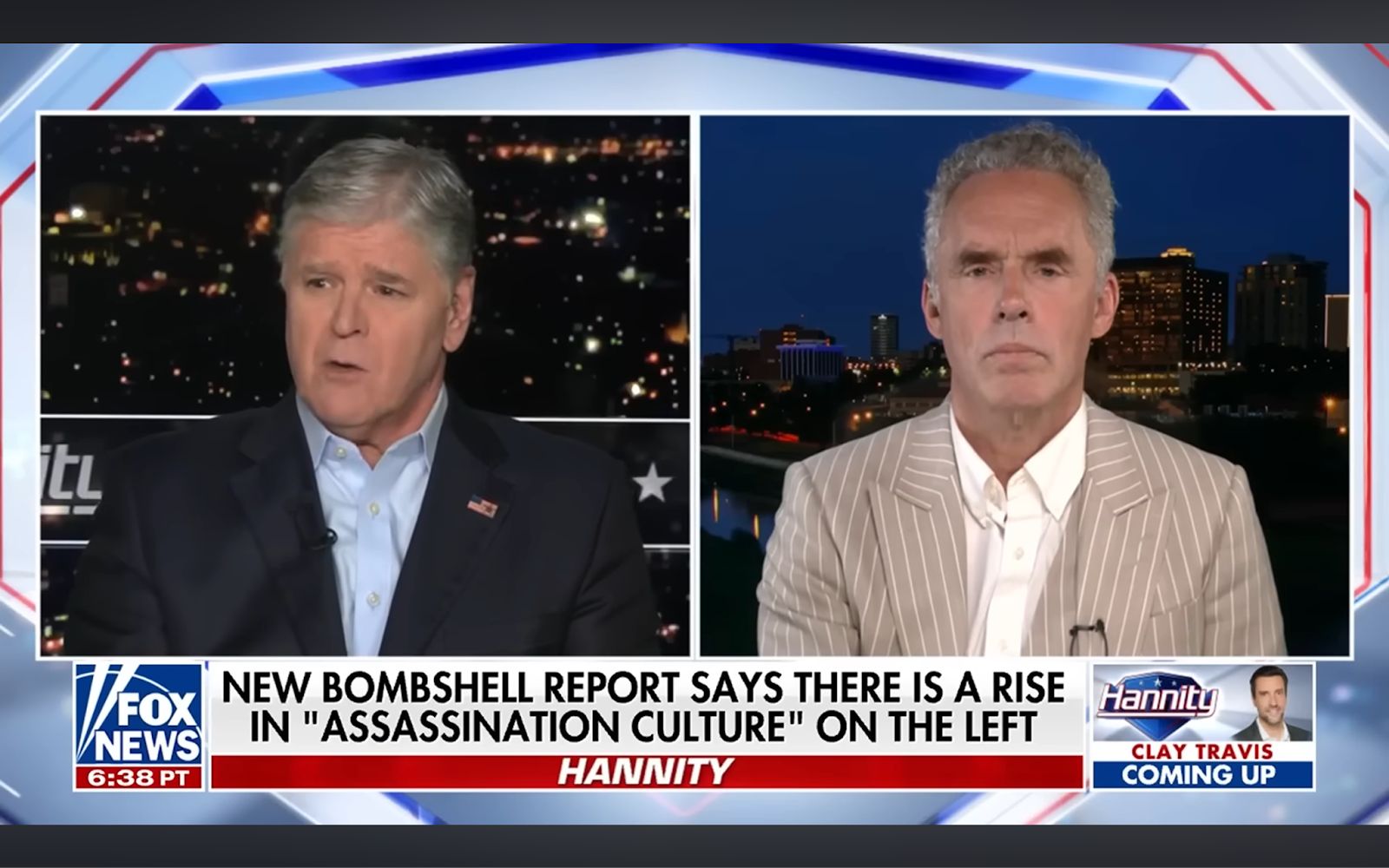
Ten years ago, Justin Brown-Ramsey became a case study of precarious manhood, lashing out when he began thinking that trans people were a threat. At 18 years old, and in search of an escape from his parents’ divorce, he started binge-watching YouTube lectures from Jordan Peterson, a clinical psychologist who’s best known as an outspoken anti-trans thought leader and has said that using someone’s preferred pronouns is the road to authoritarianism.
“He has a degree, he’s working at an institution, it seems like if that’s the kind of guy that has this opinion, I should probably also have that opinion,” Brown-Ramsey told Uncloseted Media and GAY TIMES.
This intellectualized version of transphobia appealed to the sense of insecurity Brown-Ramsey faced growing up in a household with strictly enforced gender roles.
Eventually, Brown-Ramsey became an active participant in anti-trans rhetoric. As an anonymous keyboard warrior, he’d fight in the YouTube comments against the #MeToo, feminist and trans rights movements.
Near the end of his senior year of high school, Brown-Ramsey brought this hatred into the real world against another classmate.
“They mentioned they were trans, and I recall always taking issue with that for seemingly no reason, and being just generally antagonistic about that,” says Brown-Ramsey, now 28.
He purposefully misgendered the student in class and started lashing out against friends, family and romantic partners until he was almost totally isolated.
“I think over time, the less acceptable my behavior was for people in person, the more it became acceptable to lean into the online version of that,” he says. “It went from those lecture videos to watching long rant videos about trans people and gay people, or seeking out stuff that was more 4chan-adjacent.”
Brown-Ramsey, who eventually left the alt-right after deeply engaging with U.S. history in college, believes he was manipulated to hate trans people because it helped him displace his anger about other elements of his life. “I think it was the fact that I was lower working class or lower middle class, and didn’t have an economic future ahead of me,” he says. “I was like, ‘Well if the world is that way then I just might as well be hateful and try to be more powerful than somebody.’”
Undercover in the Alt-Right
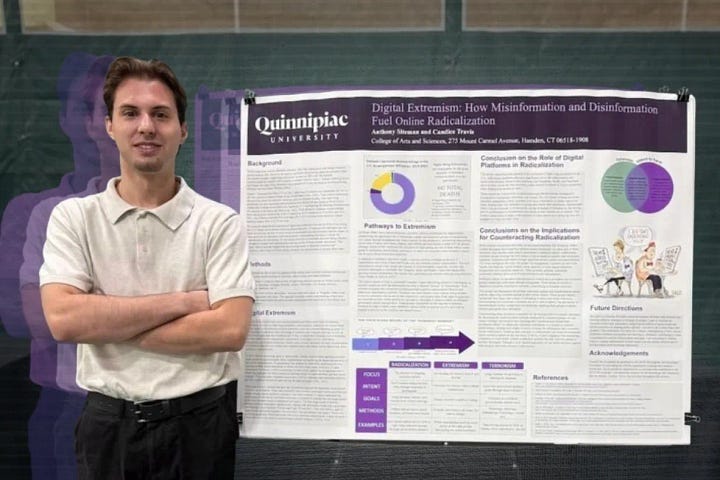
This phenomenon of young men getting drawn in by alt-right algorithms fascinated 21-year-old Anthony Siteman, who started investigating online extremism ahead of the 2024 presidential election.
“My main goal was to understand how and why people became radicalized,” Siteman, a senior at Quinnipiac University, told Uncloseted Media.
Siteman immersed himself on right-wing sites like Rumble and Gab as well as encrypted messaging apps like Telegram where he joined channels that included Proud Boys. He noticed trends that draw people in: all caps text, red alarm emojis and inflammatory language, which all trigger a sense of urgency and concern.
He saw constant racist, sexist and transphobic language, but also violent videos and memes created from the livestreamed footage of the 2019 mosque shootings in New Zealand that left 51 people dead.
Even though he entered this project to learn about indoctrination, sometimes he felt his own views slipping. “ I was really questioning myself and what I believed,” he says, adding that he had to turn to his professor to keep him grounded. “They make you really question all of reality.”
“Social media companies are feeding people more extreme content, more emotional content,” Vandello says. He explained that emotionality is what has made the online alt-right successful at manipulating users against transgender people.
Siteman agrees: “ It’s always framed about fear, anger, and just some sense of belonging.”
The Way Out
Siteman believes that to exit these spaces, people outside the alt-right should use empathetic communication to help those in their network who have been radicalized.
For Brown-Ramsey, it was a professor that pulled him out.
“Unlike online spaces, where I curated the information that I wanted to see, and the algorithm fed me more of the same bigoted, hateful content, college was perhaps the first time I was required to engage with media outside of my usual diet,” Brown-Ramsey published in an essay about his experience.
Brown-Ramsey had to read books aloud in class like “Narrative of the Life of Frederick Douglass,” which detailed the abolitionist’s experience being born into slavery. “The narrative turned a mirror onto me and, in upsetting detail, showed me that my inclinations toward antagonizing those who looked, acted, or believed differently than myself [were the same beliefs that] led to Douglass’ dehumanization,” he wrote.
“That trajectory is really just me learning, ‘Why should I be at odds with a trans person if both of us work crappy jobs and can’t pay our bills?’ Obviously, that’s not who I should be angry at, but it took a while to get around to that,” Brown-Ramsey says.
If objective, nonpartisan, rigorous, LGBTQ-focused journalism is important to you, please consider making a tax-deductible donation through our fiscal sponsor, Resource Impact, by clicking this button:


Mr anonymous, you just put forth your opinions about trans people being an ideology, but you don't substantiate your claims. Even your detransitioner examples? Where are they? I read the detransition articles all the time, and most of them are full of anger, and the blame is on trans people and transitioning, when they should look at their own projection and failure to take personal responsibility for what they did and chose to do. If you read closely, many detransition articles don't really talk about regret in terms of solid examples of how they were harmed. And there's not always a case of clear-cut regret, but those are the only ones you will read about mostly. If they got a mastectomy or other surgeries, there's no actual mention that the surgeon was incompetent or that there were complications. But oh do they try. The Genspect people. The detransitioner got the transition services they needed. And apparently one time we're just like us: consumers who should be educated and work with their providers. And since I'm trans and I'm fully engaged with these systems, I know it's not an overnight quicky kind of thing. There are papers to sign, things to discuss, and time drags on. It's not like going to a drive-through restaurant and pulling up to the window and getting everything you want in one shot. And we can study detransition and find out why some were still not satisfied. Because there will be a percentage of failures --that is the case for all of medicine. But most of it does not have to do with transitioning and gender-affirming care being a failure. They went through a process that's actually lengthy and not an overnight sensation, as transition is said to be. They sought the services of healthcare and medical professionals. They went through a process. A process that allows adequate time to back out. Sure there may be problems but then let's talk about the actual problems but not painting every trans person with the same brush and advocating for our complete eradication from society (including our health care, access to government agencies, insurance, and so much more). Instead, I suspect many of these people are showcased by the anti-trans crowd on Substack, which is not just a huge number -- but an army. And I had more to say about this but it's late and I'm not going to leave even a longer comment. But people like you don't really know what the process is, and what trans lives are like. You operate from your keyboard and pretend you've done your due diligence. And believe you really know about our lives. You are so heavy into politics and ideology and worrying about culture wars, but I don't see you as somebody open-minded, capable of responsible public discourse, and truly wanting to investigate a situation with an intellectual curiosity and Goodwill towards understanding and solutions.
I mostly keep my mouth shut, but people like you get on here and you pedal the same stuff. And I've read many many articles about trans people on Substack -- both pro and con. Over the last year and a half and particularly the last few months. We're not some dangerous ideology, and there's nothing many of you can really hang your hat on. You're just winging it, and it's conjecture. And you create a fantasy in your minds because you're equally obsessed --just the way you think trans people are. And there's hardly enough pushback on Substack, so you folks get away with it and people buy into it. You bought into a fiction and fantasy created by the extreme right, the Republicans, the Vatican, and the whole bunch of them -- that are deciding a narrow and very limited way of being regarding public and private life for Americans. It's exclusionary. And queer and trans people are just plain not part of their picture. You folks talk about identity, but our identity and existence is to be denied as policy. Eliminating us means that we don't have to be dealt with. And there is therefore no need for necessarily services or accommodation of any sort. That's the plan. I was reading today about SCOTUS and was reminded that people like Justice Amy Coney Barrett don't even see us as a class of people. And the logic is we can't be wronged because we don't exist as a class of people. WTF? They just wrote us off. To you we are a fringe group, but to ourselves we are people who are expected to be treated as productive citizens in society, with a legitimate identity and to be members of the population in good standing. And a group that could actually be wronged and there should be remedies based on laws that protect us. But that gets stripped from us. And folks like you get on here and you want to strip us of any credibility and rights.
And mention of the Heritage Foundation is where I would like to see more emphasis, because these are the people that are actively damaging trans people right now. These type of well-funded organizations. We can debate history and we can go over what happened 20 or 30 years ago -- and go all the way back to Reagan, Rush Limbaugh, and conservative beginnings -- and the momentum they built quietly to arrive at this moment for the last year now. Or juxtapose the trans experience with gay history and homosexuality exclusion in decades past. But what is happening now is unique and completely separate from those past times and past presidencies. People cannot talk about us without bringing us into their own perspective and lives. Everything about us is framed from everybody else's perspective, schema, blueprint, and model for living. We have our interests, separate goals and expectations. No, we are not like you. And we are not the LGB_QIA+ stepchildren.
I've kept it civil, which is not easy to do.
Good night. HH
I will go through the article in sequence.
Joseph McConville’s story. Good job finding someone to corroborate the idea of alt-right radicalization. I can find plenty of detransitioners to make the same accusations about the trans community. If you dismiss them, you can’t accept him.
>This change in public perception may be because of the growing claims that falsely link transgender people as perpetrators of mass violence and domestic terrorism.
There has been links to trans identity or ideology in recent shootings. This is a trend that seems to be increasing and is more prominent due to trans-activism. Combine that with popular rhetoric of threatening violence against TERFs, “punch a nazi” (and then label everyone in disagreement as a nazi), the existence of Trantifa, and general hate and death-threats online, it is a fair question to ask: has a certain proportion of the trans community changed public perception for the worse all by themselves?
There is considerable overlap between the trans-activist and progressive anti-capitalist/anti-colonialist/anti-racist communities. They don’t worry about hiding their contempt for the family, for straight white men, the USA, and capitalism. They are happy to agitate for socialism/communism.
>Since 2022, Americans have increased their favorability towards laws limiting protections for trans people and have become less favorable towards policies safeguarding them.
This is a one-sided framing of the issue that fails to provide ANY example and any counterargument. TERFs aren’t alt-right and they vehemently oppose “inclusive” policies that, from their perspective, removes the rights of women to have spaces free from men.
This is a point of ideological conflict: that a male can never be a woman, not ever; that womanhood is not relegated to a costume; that “gender” as a social construct requires biological intervention in case of dysphoria (for “truscum”) or just anyone who wants it.
>But how did Americans get taken to believe this anti-LGBTQ lie?
It’s not “anti-LGBTQ”. It’s a refusal to buy into the lie of “transgenderism”. There are many gay and lesbian people who don’t want the TQ bundled with them. “Trans” isn’t a sexuality, and “Queer” is largely a political identity.
Then the article quotes Thekla Morgenroth who absolutely infuses politics into research:
https://hhs.purdue.edu/directory/thekla-morgenroth/
https://scholar.google.com/citations?user=7IFk888AAAAJ&hl=en&oi=ao
A good example is: The effects of gender trouble: An integrative theoretical framework of the perpetuation and disruption of the gender/sex binary
>[M]any of the people behind the rhetoric today hold powerful positions in the government.
Goes on to mention 3 people: Boebert (rep for Colorado), Dillon (ast. DOJ AG), and Paxton (Texas AG). You want to blame them? Fine, if that’s the case, we can hold the following people accountable for words promoting violence:
Joe Biden "It's time to put Trump in a bullseye."
Kamala Harris "They’re not gonna stop... and everyone beware, because they’re not gonna stop... and they should not."
Nancy Pelosi "I just don't even know why there aren't uprisings all over the country, and maybe there will be."
Chuck Schumer "I want to tell you, Gorsuch. I want to tell you, Kavanaugh. You have released the whirlwind and you will pay the price. You won’t know what hit you if you go forward with these awful decisions."
Ayanna Pressley "There needs to be unrest in the streets for as long as there’s unrest in our lives."
Maxine Waters "We've got to get more confrontational. We've got to make sure that they know that we mean business."; "If you see anybody from that Cabinet in a restaurant, in a department store, at a gasoline station, you get out and you create a crowd. And you push back on them. And you tell them they're not welcome anymore, anywhere."
Dan Goldman "He is not only unfit, he is destructive to our democracy, and he has to be eliminated."
These are just a few examples. That’s not including the relentless media bias and general ridiculous demonizing language from Democrats.
More from Morgenroth:
>People are very attached to the way that they think about gender because it gives them a sense of certainty—it gives them a sense of who they are and who they’re not
The sex/gender split and subsequent equation of gender with gender identity was a genius rhetorical divide but regardless of whether you want to differentiate biological sex (if admitted as a reality, which not all activists do; Morgenroth seems to have ignored Paglia completely) from experience of one’s sexed identity (“gender”). People are uncomfortable with a movement that pushes them to deny reality and essentially participate in delusion.
>Vandello says many young men fall for anti-trans narratives because they confirm their place of privilege in the world and validate their insecurities
Based on what? This is pure assertion, that men believe that should hold a place of privilege. His research doesn’t support that link. It doesn’t account for status loss in contexts where trans ideology is readily embraced, such as clinical psychology graduate school, where any opponent, not just men, risk such loss. There are also other potential correlational effects. His conclusion is specious at best.
Here’s a nice strawman:
>Jordan Peterson, a clinical psychologist who’s best known as an outspoken anti-trans thought leader and has said that using someone’s preferred pronouns is the road to authoritarianism.
Peterson didn’t say “using someone’s preferred pronouns is the road to authoritarianism”. He decried legally compelled speech. He specifically called out a Canadian law that effectively made it criminal to NOT use pronouns. Bill C-16 amended Canadian human rights law to include gender identity/expression as protected grounds and then noted that the Ontario Human Rights Commission had already interpreted refusal to use preferred pronouns as discriminatory harassment and handed out fines to people.
If the article was honest and in good faith, he would describe Peterson as saying, “legal compelling individuals to use preferred pronouns is the road to authoritarianism.” That’s an accurate representation.
Another anecdote, this time Justin Brown-Ramsey. He didn’t get that opinion from Peterson. He utterly misunderstood the argument. By the way, Peterson’s catalogue of lectures existed on YouTube prior to any of this. He has never said what people accuse him of saying.
>“Social media companies are feeding people more extreme content, more emotional content,” Vandello says. He explained that emotionality is what has made the online alt-right successful at manipulating users against transgender people.
This is true, and it applies to the communists and trans activists. It applies to any fringe ideology.
>Siteman agrees: “ It’s always framed about fear, anger, and just some sense of belonging.”
The lack of awareness here is astounding. This is what many fringe movements are based on. Yes, some of the alt-right are about this, and so some people in street gangs, trans movements, antifa, political groups, racial groups like the KKK and BLM, etc, etc.
And here we go… the underlying political statement:
>“That trajectory is really just me learning, ‘Why should I be at odds with a trans person if both of us work crappy jobs and can’t pay our bills?’ Obviously, that’s not who I should be angry at, but it took a while to get around to that,” Brown-Ramsey says.
“Don’t be mad at trans people, hate the capitalists! Hate the country! Hate your family! Us reds will embrace you!”
That’s what makes this article utterly garbage.