

What Do Canadian Separatists Want for LGBTQ People? Albertans May Soon Find Out
Earlier this week, Premier Danielle Smith formalized a separation question that Albertans will vote on later this year. What could sovereignty mean for queer people in the province?

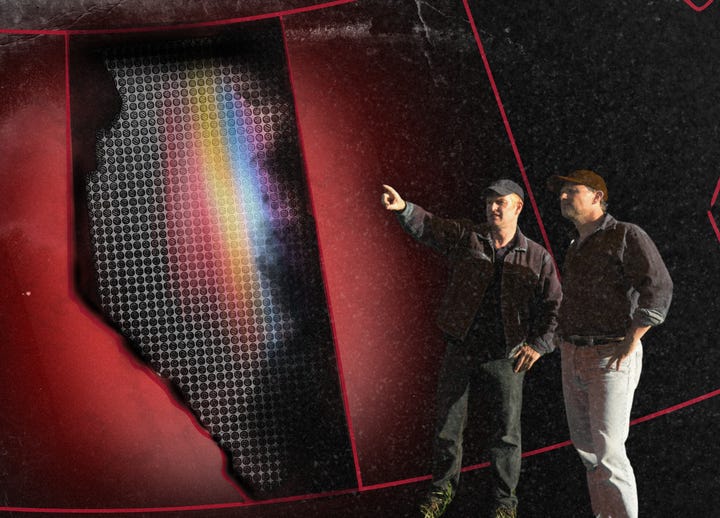
This story was originally written for Gay Times Magazine.
On a Friday afternoon in February, Teresa McCleary and Rose Milner sat near the entrance to Calgary’s Boddums Up Pub, collecting signatures for a petition pushing for Alberta—which is widely recognized as Canada’s most conservative province—to separate from the rest of the country.
“I want the old Alberta back. I want our free Alberta back. … We are a cash cow for the East. They don’t care about us,” says McCleary, who sported a baseball cap with the words “I am Albertan!”
As for Milner, she feels Canada is becoming “communist.”
“Bring back the ‘60s,” she told Uncloseted Media and GAY TIMES. “I don’t give a shit who you love, but don’t shove your ideology down my throat and tell me that I need to use pronouns.”
Milner and McCleary represent a subset of people in Alberta who are hoping their province will become a nation unto itself. And on Oct. 19, Premier Danielle Smith’s government will ask Alberta voters to answer nine questions, one of which will ask them to pick between two options:
“Alberta should remain a province of Canada.”
“The Government of Alberta should commence the legal process required under the Canadian Constitution to hold a binding provincial referendum on whether or not Alberta should separate from Canada.”
If a majority of Albertans vote in favor of more autonomy, the province would not immediately secede from Canada. Rather, Alberta would proceed to engage in negotiations with each province’s legislature, as well as the government of Canada, before any formal changes could be made.
Though Alberta’s path to sovereignty may be vague, the prevalence of far-right views within the independence movement are clear. And with a provincial government that has passed anti-trans laws, what could separatism mean for the rights and safety of LGBTQ Albertans?
Janis Irwin, a queer member of the legislative assembly (MLA) in Edmonton, urges Albertans to take the issue of separatism seriously. “I worry deeply for what would come if separatism were to move forward,” Irwin told Uncloseted Media and GAY TIMES. “We dismiss this conversation at our own peril.”
Separatists and LGBTQ Rights
While separatist sentiment in Alberta can be traced back to Alberta’s entrance into the Confederation in 1905, it has grown significantly in recent years. Alberta is the province with the highest GDP per person and possesses 97% of the country’s oil reserves. Because of this, many separatists believe the province would be better off as an independent country.
But beyond economics lies an ideology rife with anti-LGBTQ sentiment. In the Alberta Prosperity Project’s (APP) “Proposed policies and governance for a sovereign Alberta within or without Canada,” they write that in grades K-12, the government will “ban any and all forms of critical race theory,” as well as “ban gender grooming.”
The APP, an organization spearheading the push for independence, also writes that family is “the moral, social, and cultural pillar of society,” and that parents should be able to choose “the kind of education that shall be given to their children, including the content … as well as the nature, culture, and character of their children’s learning environment.”
While this language may sound innocuous, Jamie Anderson, Ph.D. candidate at the University of Calgary whose work focuses on LGBTQ issues in education, says that isn’t the case.
“Parental rights is something that we should understand as a dog whistle,” Anderson told Uncloseted Media and GAY TIMES. “It reflects some of the recent policy changes that we’ve seen, [including] parental control over books and libraries [and] parental control over access to gender-affirming care and access to social transition.”
When it comes to trans rights, separatists are more aggressive in their goals. In another APP document titled “The rationale for restructuring Alberta’s relationship with Canada,” the organization states that “promoting the teaching of transgenderism to children who are not yet at the age of consent” is contributing to the “fracturing of society.”
Anderson says this language mimics far-right strategies rooted in transphobia: “This draws on a longstanding tactic that’s been used against queer and trans inclusion for decades: the idea of social contagion of identity, that if we expose kids to ideas about queer and trans identity, that they will become that, as opposed to queer and trans identities just existing as a normal part of existence.”
Still, separatists like Milner agree with the parents’ rights movement, which has attempted to ban LGBTQ education.
“I don’t believe it should be taught in schools,” says Milner. “Some of these people they had come to the schools, our children don’t need to see them, talking about gender and sexuality and stuff like that.”
Feodor Snagovsky, professor of political science at the University of Alberta, says that Milner’s attitude is common among separatists. “Within the movement, many think that LGBTQ issues are too prominent within the education system and that teachers are more or less indoctrinating kids with a sort of pro-LGBT mindset,” he says.
Separatists and Anti-LGBTQ Rhetoric
Not only could APP’s proposed policies be harmful to queer Albertans, but the rhetoric of some of the movement’s other leaders is also dangerous. Alberta 51 Project, an organization with over 40,000 followers on X that advocates for Alberta to become the 51st U.S. state, has posted false information stating that transgender people “are responsible for 95% of mass killings and violence against actual women.” And Take Back Alberta, another separatist group, has been referred to as a “populist far-right social movement” and has made efforts to remove books with queer themes from Alberta libraries.
David Parker, a separatist and founder of Take Back Alberta, has posted that he “[doesn’t] want LGBT flags … over any government building in Alberta” because they “divide.” Parker also leads The Centurion Project, a group mobilizing Albertans to push for independence. The project recently came under fire for illegally obtaining and publishing the personal information of nearly 3 million Albertan voters. Parker did not respond to GAY TIMES and Uncloseted Media’s interview request.
Other rhetoric is implicit. For example, one APP post advocates for “Protecting the Right to Share Scripture Freely.” While this may seem benign, Anderson has concerns.
“A lot of people in the independence movement speak of having their own constitution where freedom of speech and expression without suppression is protected,” he told Uncloseted Media and GAY TIMES. “I think that speaks to favoring a rights-based form of freedom of speech that does not account for discrimination [or hate speech] as a limiting factor.”
Connection to the UCP and Anti-LGBTQ Policies
While Alberta’s separatist groups are not formally associated with any political party, the United Conservative Party (UCP), which leads the provincial government, has ties to the movement. Conservative MLA Jason Stephan encouraged Albertans to sign a petition which allowed the question of separation to be added to October’s referendum ballot. And though Danielle Smith, the leader of the UCP and Alberta’s premier, says she has not signed the petition, she has refused calls to denounce the push for a sovereign Alberta.
And after Smith made remarks in support of restricting gender-affirming care for minors and mandating that schools inform parents if their children change their name or pronouns, APP called the speech “energizing.”
Smith has also passed legislation that prohibits gender-affirming surgeries and limits puberty blockers and hormone replacement therapy for minors. To do this, she followed in the footsteps of Alabama’s chief deputy attorney general and relied on the testimony of an expert witness who was hired by Alliance Defending Freedom, a Southern Poverty Law Center-designated anti-LGBTQ hate group.
Jennifer Johnson, another MLA and UCP member, has referred to transgender students as feces in food and has voted in favor of a bill which saved the referendum for Alberta’s independence from being shot down.
The Implications for LGBTQ People
With many in Alberta’s independence movement being those on the right and the far right, LGBTQ people have legitimate cause for concern. “Many folks within the movement see LGBTQ issues as ranging from irrelevant to actively pernicious,” says Snagovsky. “Many of the issues that motivate Alberta separatists are the same issues that motivate people in the far right.”
The independence movement also has ideological similarities to the likes of the late Charlie Kirk, who was known for his anti-LGBTQ perspectives. Following his death, APP made a post mourning Kirk, who once suggested that the issue of trans rights should have been “[taken] care of … the way we used to take care of things in the 1950s or ‘60s.”
If Alberta were to become an independent country, federal protections for LGBTQ people would no longer apply. Most notably, the country’s charter—a foundational document protecting the rights and freedoms of Canadians to live free from discrimination based on many things, including sexual orientation and gender identity—would cease to safeguard queer Albertans.
As far as McCleary is concerned, LGBTQ rights, including gay marriage, would need to be revoted on. “When Alberta becomes independent, all of Alberta will decide,” she says. “It’s not cut in stone.”
Janis Irwin says she has concerns: “If we have a UCP government that’s already willing to attack queer and trans rights within the confines of a country that has a Charter of Rights and Freedoms, why would there be any impetus for them to try to protect our rights in an independent country?”
Back at the Boddums Up Pub, McCleary is excited about the prospect of independence. “I want to see our old, free and strong Alberta,” she says.
As far as Anderson is concerned, the freedom McCleary dreams of does not safeguard the liberties of all Albertans. “There’s a significant cognitive dissonance, because this idea of freedom is less about individual liberty, and more about freedom of majority dominance,” he says. “They’re not concerned about individual liberties of queer and trans people.”
If you’re in Canada and would like to donate, you can make a charitable tax-receipted donation here:
If objective, nonpartisan, rigorous, LGBTQ-focused journalism is important to you, please consider making a tax-deductible donation in the U.S. through our 501(c)(3) fiscal sponsor, Resource Impact, by clicking this button:

 | A guest post by
|
A large core of this group are radical Dutch evangelical Christians who came to Saskatchewan and Alberta after Holland became more progressive with social culture. This has been decades in the making. In some parts of Alberta they are referred to as the Dutch Mafia. Wow. They found the internet and have mobilized to take Alberta down. David Parker is of this lineage. He has been quoted as saying the Dutch are smart so do not underestimate their power. Very worrisome.
Complete and total Indigenous erasure..