

Inside the Very Lonely World of Trans Conservatives
Even though the Trump administration has waged an all-out war against trans Americans, as many as 10% of them identify as Republican. Why?

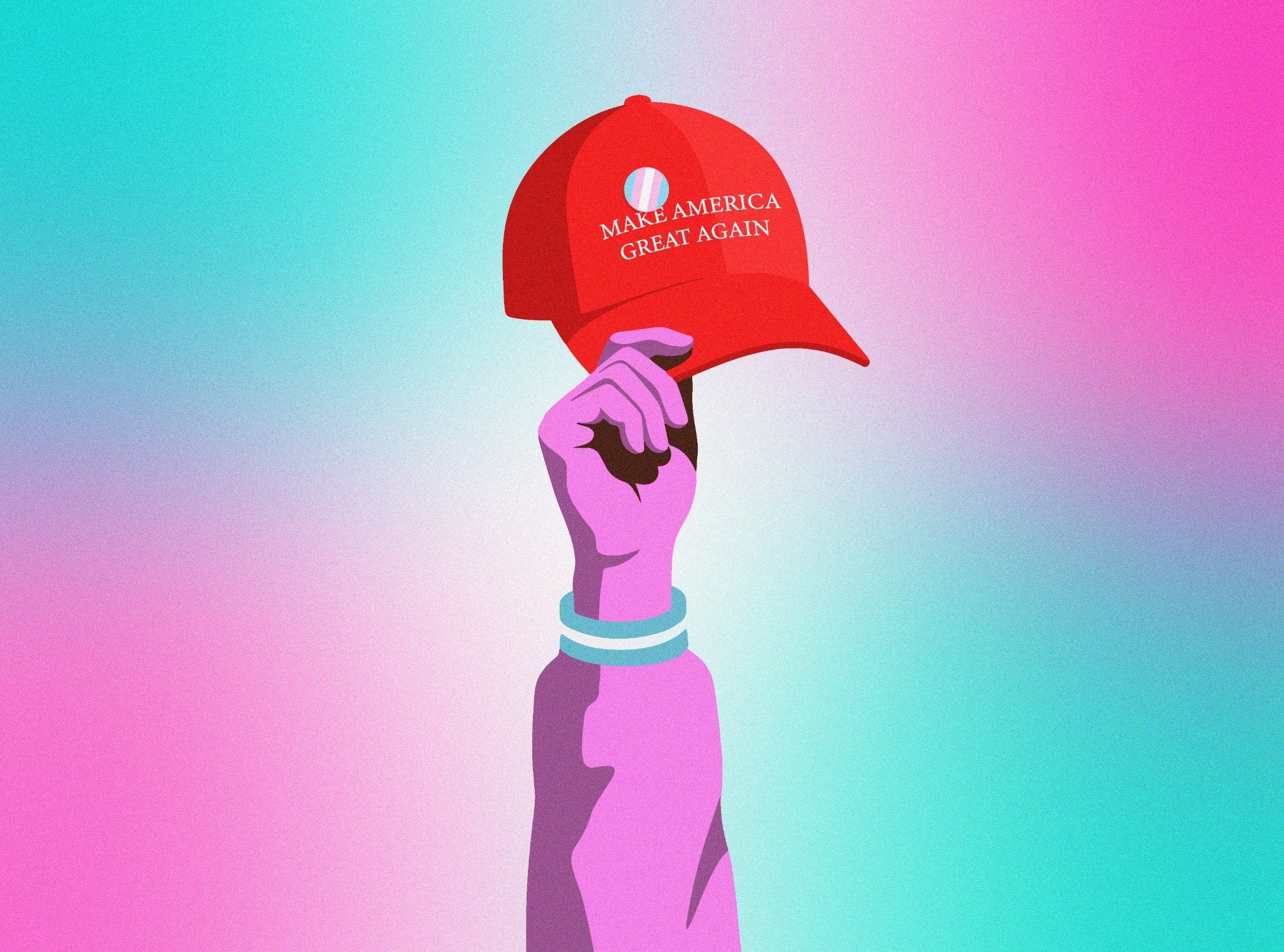
This story was written in partnership with Gay Times Magazine.
After spending the first 82 years of her life keeping her trans identity a secret, Sandra Kaye finally came out last year. But it wasn’t long before Kaye—a lifelong Republican who lives in Texas—found herself dealing with tension between her gender and her political views. A conversation with a left-leaning friend led Kaye to feel confused and unsure about her longstanding affiliation with the GOP.
“[My friend] has always been a little bit left, and I’ve always been a little bit right. So she asked me a question one day: How can I be trans and a Republican?” Kaye told Uncloseted Media and GAY TIMES. “I was not prepared for that question.”
Since this conversation, Kaye has moved further towards the center and now considers herself an independent. However, she is still proudly conservative, and voted in Texas’ Republican primary on March 3.
Kaye is in the small minority of trans people who hold conservative views.
According to a 2022 survey conducted by KFF and The Washington Post, 10% of trans U.S. adults identify as Republican. These numbers are likely continuing to dwindle as the Republican party pushes transphobic rhetoric and policies. During the 2024 presidential election, Trump and the GOP spent more than $215 million on anti-trans ads. And as president, he has eliminated the federal recognition of transgender identities and introduced a counterterrorism strategy that vows to crack down on “radically pro-transgender” extremists.
Still, some trans Americans stand by their conservative beliefs.
“When you get right down to it, I don’t think the Republican Party itself is anti-trans. I think the anti-trans comes from Donny Boy,” says Kaye, referring to Trump.
For These Trans Women, Voting Conservative Makes Sense
Kamryn Wilson, a 25-year-old trans woman in Iowa, also holds right-wing beliefs. She is a member of Young America’s Foundation (YAF), an organization dedicated to helping young conservatives spread right-wing values on university campuses. Sen. Ted Cruz has spoken at YAF events, and the organization’s president, Scott Walker, has a track record of supporting anti-LGBTQ policy.
Though Wilson believes there are transphobic voices within the Republican Party, she does not see them as fundamental to the ideology of the GOP. “The conservative party is not a party that is designed to hate trans people,” Wilson told Uncloseted Media and GAY TIMES. “There are people in higher-up positions in the [GOP] that are not fond of trans people, and they voice those opinions very loudly. But it is not a consistent [ideology].”
Wilson thinks concerns that Trump is curtailing trans rights are overblown. She believes the president is exclusively concerned with trans people on the far left, who she sees as having a tendency to exaggerate. “He’s coming for a subset of the trans community. The same people that have constantly said that misgendering someone is violence are the same people saying Trump is coming after [them],” she says. “Trump is coming after far-leftism.”
Though Wilson believes Trump’s threats are overblown, the president has passed a litany of anti-trans policies. These include banning trans and nonbinary people from military service, removing the T from LGBT on government websites and banning trans people from receiving passports with the correct gender marker.
Despite this, Wilson says she hasn’t faced significant hardship under the Trump administration. “Nothing of note has really happened to my rights.”
While Wilson may feel protected under Trump, a 2024 survey of trans Americans found that 42% had taken steps to legally protect themselves following the 2024 presidential election. Meanwhile, 83% had increased concerns about their mental health.
As a right-leaning trans woman, Wilson believes she is able to influence those around her who may be skeptical about trans people.
“I find that they tend to listen to someone like me a lot better, not because I’m bowing down to them, but because I can share ideas with them,” she says, adding that people who have doubts about trans rights are misguided. “It’s not really transphobia that is going around, it’s trans stereotypes that are being inflated by these hyper-vocal groups, and that’s where conservatives get these ideas of what the LGBT community in general is about.”
Wilson feels that some trans women are spreading misleading and harmful perceptions of the community. “A lot of people on the left love to over-embellish things and make it seem like anyone that has any sort of opposition to trans people is immediately this bigoted transphobe,” she says.
They Don’t Always Agree with Trump
Though Kaye voted for Trump in 2016 and 2020, she says she did so “under duress” and was never fully a Trump supporter.
Her vote was instead a response to her wariness of the left. “I am of the anti-communist age. That was drilled in my head for years and years and years,” she says. “It’s still there, and I still believe it. I could not vote for Joe Biden.”
When the 2024 election came around, Kaye saw the same “communist” messaging from Kamala Harris. “When we got around to the young lady that ran this last time, all I could hear coming out of her mouth was communist leanings,” she says. While Biden and Harris are not communists, Kaye’s views reflect a popular right-wing political tactic involving painting those on the left as such.
Despite having voted for Trump twice, Kaye does not support the administration’s crackdown on immigration. “We should not have the SS out there grouping people,” she says, comparing ICE to Schutzstaffel, a major Nazi paramilitary group abbreviated as SS. “The leadership of the United States is so close to the fascism of Germany and World War II. It is downright scary.”
A key issue fueling Kaye’s and Wilson’s conservatism lies in access to guns, which both women believe are critical to their freedom and self-defense. “You’ve got people on the far left who do not want you to be able to defend yourself,” says Kaye, who is a former firearms instructor. “I believe in the Second Amendment.”
Wilson believes guns are necessary in order for Americans to keep their governments in check. “I’m an American. Our nation was founded on the idea that we have the ability to stand up to our own governments, and we cannot [do that] if we are not equipped,” she says.
In April, the Trump administration proposed a rule which would make it harder for trans people to access guns by requiring them to list their assigned sex at birth on purchase paperwork. The National Rifle Association publicly opposed an earlier version of the rule, which would have classified trans people as mentally ill and thus banned them from owning guns outright.
While most of the trans people Uncloseted Media and GAY TIMES spoke with for this article weren’t outright Trumpers, they were all conservative. Barbara Minney, a 73-year-old trans woman in Ohio who has doubts about Trump, describes herself as a “conservative/moderate/common-sense transsexual woman.”
“I was 63 when I transitioned, and when you transition that late in life, most of your core beliefs and values have been ingrained over that period of time. It’s hard to change those beliefs and values … after suddenly becoming part of a new community,” says Minney. After voting for Trump in 2016 and 2020, Minney chose not to vote in 2024 because of pressure she felt from Democrats in her life.
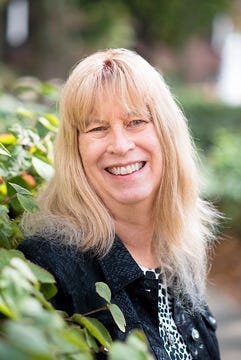
Without that influence, she says she likely would have voted for Trump in part because of his immigration policy. “I believe that people who came into this country illegally committed a criminal act and should be dealt with,” she says.
Still, Minney doesn’t like the anti-LGBTQ rhetoric from the administration.
“But he does have LGBTQ people as part of his cabinet, so I respect that,” she says. “Trump sends a lot of mixed messages, and it’s hard to read and understand what his true thoughts are.”
How Do They View Trans Rights?
Minney’s views on trans rights differ from the majority of trans women. “I always describe myself as a transgender woman. I’m not just a woman, because I understand that I’m not a woman,” explains Minney. “I present as one. I am perceived as one, but deep down, I know that I will always be different.”
Alaina Kupec, a former Republican and the current leader of Gender Research Advisory Council + Education, a trans advocacy nonprofit, says that while she understands people like Minney’s desire to “give space” to cisgender women, other trans people shouldn’t be expected to view themselves the same way.
“If she wants to identify that way for herself, she’s entitled to that perspective,” Kupec, a Navy veteran, told Uncloseted Media and GAY TIMES. “I don’t think that she can use that same rationale for anybody else outside of herself, because the community is so broad. … I don’t think that it’s correct to say that any woman who is transgender is any less of a woman.”
Minney also differs from most trans people when it comes to policies surrounding bathrooms. While she does use women’s restrooms and locker rooms, she understands if some cisgender women don’t feel comfortable in her presence. “I believe that we have to be mindful of the spaces that women want to preserve for themselves,” Minney told Uncloseted Media and GAY TIMES. “I would respect their desire to have a biological women-only space.”
Similarly to Minney, Wilson believes transgender people should be able to use bathrooms that correspond to their gender, but she thinks this access should only be granted to trans people who “pass,” meaning their appearance is perceived as aligning with their gender.
“People that have been transitioning for one to three years, then we can talk about using the women’s restroom. Those people start to have more estrogen in their system than testosterone, and they tend to live life very femininely,” she says.
Because Wilson herself is early in her transition, she chooses to use the men’s restroom. “I think that there should be a passability line,” she says. “I started HRT about a month and a half ago. I’m nowhere near that line yet.”
Kupec says that, while she respects Wilson’s decision, the notion of passing is too complex and subjective to impose on other people. She also says that inviting legal regulation on such an issue is actually antithetical to the traditional conservative value of small government.
“If she doesn’t feel safe going into a women’s restroom, then she should not go into a women’s restroom, and any trans person should have that same autonomy to make that decision for themselves based on their situation and their personal feeling of safety,” Kupec says. “I don’t think there’s a litmus test that you can put out there that’s a line in the sand because everyone’s going to be different. … By arbitrarily putting lines in the sand, you’re inviting more regulation into something that common sense could take care of anyway.”
Another area in which Wilson is likely to disagree with other trans women lies in access to gender-affirming care. “That’s something that I think [Trump] has done really well is up the age for puberty blockers to 19. Personally, I still think it should be older than that.”
Despite Trump having barred federal funding for youth gender-affirming care, a study published in 2022 found that such care has been associated with lower odds of depression and suicidality in American children.
Backlash From Others in the LGBTQ Community
Wilson says she faces backlash “all the time, literally every single day” from others in the LGBTQ community for her political views. She says being conservative has made it hard to get past a first date; a recent phone call with a crush didn’t pan out after Wilson mentioned her political affiliation.
“We had a call and we talked for an hour, and at the end, I had mentioned something about being Republican. It went from ‘She seems very interested in me,’ to ‘Now she’s becoming very standoffish,’” Wilson remembers.
Wilson has also been banned from various online LGBTQ communities after revealing her politics. “I’ve had people literally kick me out of Reddit communities, Discord communities, Twitter communities, Facebook, you name it, all of the above because I have political views that differ from others.”
Minney says she has learned to stay quiet about her politics in queer spaces. “I very rarely talk about my political beliefs. But when I did, I was called a monster, an enemy of humanity, and other names that I can’t even repeat,” she says.
Minney believes many trans conservatives stay quiet about their beliefs and questions the extent to which she is a political minority. “I think that you would be surprised at the number of transgender women and men who identify themselves as conservative,” she says. “There are probably more of us than you would think.”
Kupec has a different outlook. She says that while it may be true that some trans people hold conservative beliefs but keep it to themselves for fear of backlash, many, including herself, have been pushed away from American conservatism because of the Republican Party’s mounting transphobia.
“I am an independent who used to be a Republican until Republicans went away from their true conservative values and started getting involved with issues that personally affect me and my ability to live my life freely,” Kupec says. “Government doesn’t have a place in the bedroom and doesn’t have a need to regulate everything, which is not what we’re seeing in today’s Republican Party and what some people call conservatism.”
Additional Reporting by Hope Pisoni
If objective, nonpartisan, rigorous, LGBTQ-focused journalism is important to you, please consider making a tax-deductible donation in the U.S. through our 501(c)(3) fiscal sponsor, Resource Impact, by clicking this button:

 | A guest post by
|